


I spotted an Elbows Up sticker on the back of a pick-up truck as I was walking through downtown Toronto, and it gave me the creeps.
When that slogan was first used, I liked it, I felt it was about putting Canada first and fighting for the country. Now it feels like Elbows Up is only about sticking it to Trump and being angry at Americans even if doing so hurts Canada.
So, it was nice to listen to Pierre Poilievre in the House of Commons today putting forward a positive view for how Canada can attempt to deal with Trump and try to get a good deal for Canada.
He did this during his appearances on Joe Rogan and on Bloomberg TV over the weekend as well. In Poilievre’s view Canada has leverage and we aren’t using it the way that we should.
Today he was speaking to his opposition day motion on rebuilding Canada’s auto industry and relaying information to the House on his trip stateside.
Immigration in Canada is falling to pieces...
If you want to know how bad the immigration system has become, you really need to read my latest piece in the Toronto Sun.
We’ve heard about the problems with the Temporary Foreign Worker program, the Auditor General’s report on the disaster that is the student visa system and how much our asylum claims have grown. Well, on Tuesday I spent time going over the numbers to present you with facts that other media outlets won’t share with you and they are shocking.
Truly, do yourself a favour, read the column, and share it with others via email or social media.
As I was putting together the facts and writing my piece, Pierre Poilievre was trying to get straight answers from the Carney government on this issue and wasn’t having any luck.
Later, Poilievre fired off a letter demanding that Mark Carney fire Sean Fraser, Marc Miller and Lena Diab – the current and two previous immigration ministers.
This incompetence and reckless mismanagement of our immigration system were not only tolerated when it was occurring, but those directly responsible have also been rewarded. You gave Sean Fraser a promotion to Attorney General in your cabinet. His successor, Marc Miller, still sits at the cabinet table as Minister of Culture.
It’s therefore no surprise that your Immigration Minister, Lena Diab, has failed to bring in serious changes that would restore Canadians’ confidence in our immigration system. It’s not just Conservatives pointing this out, as nine of your Liberal MPs have been “openly questioning her place at the cabinet table,” with one saying “the minister has no idea how to respond” to basic questions on immigration.
I won’t hold my breath waiting for Carney to fire those three, though I’m increasingly finding it hard to understand how Diab is keeping her job.
The Supreme Court is considering whether to call themselves The Supreme Leaders...
Quebec’s Bill 21 is before the Supreme Court this week, and while the arguments before the court are ostensibly about the bill, the reality is this is all about the Notwithstanding Clause – AKA Section 33 of the Charter of Rights and Freedoms. Section 33 was the key to Pierre Trudeau getting the premiers of Canada to agree to adopting the Charter of Rights and Freedoms during negotiations in Ottawa in November 1981.
Take it from Norman Spector, who unlike so many who comment on these things was actually there.
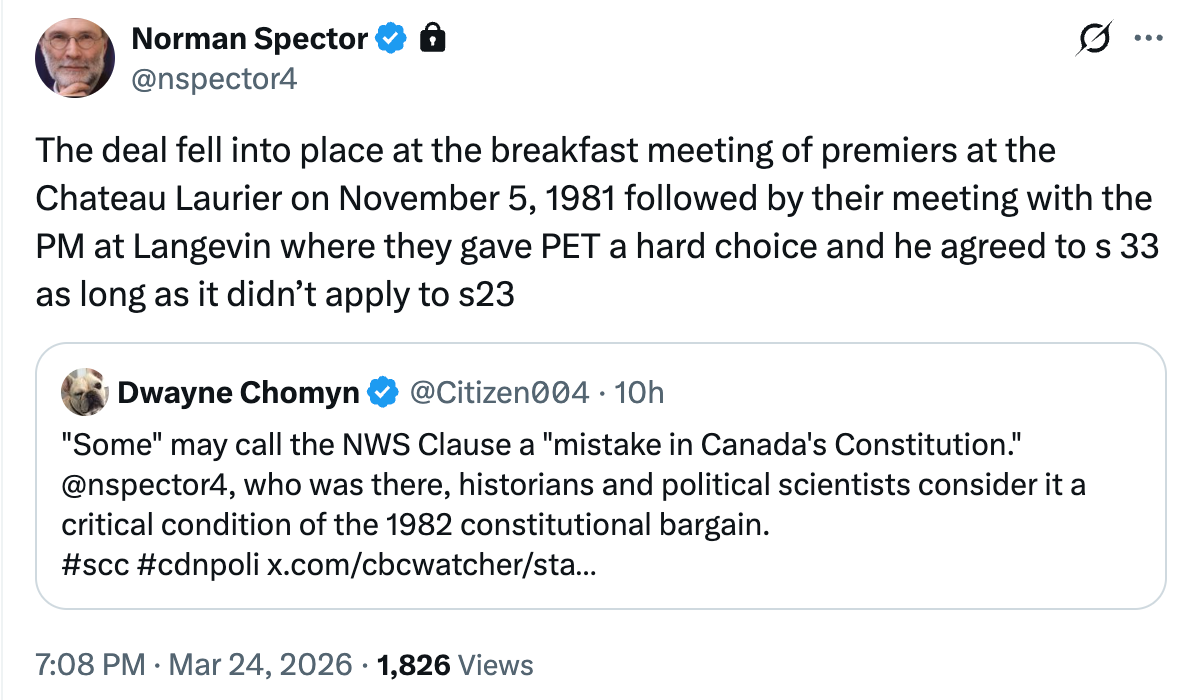
Anyway, before going on, here’s what Section 33 actually says.
33 (1) Parliament or the legislature of a province may expressly declare in an Act of Parliament or of the legislature, as the case may be, that the Act or a provision thereof shall operate notwithstanding a provision included in section 2 or sections 7 to 15 of this Charter.
Marginal note:Operation of exception
(2) An Act or a provision of an Act in respect of which a declaration made under this section is in effect shall have such operation as it would have but for the provision of this Charter referred to in the declaration.
Marginal note:Five year limitation
(3) A declaration made under subsection (1) shall cease to have effect five years after it comes into force or on such earlier date as may be specified in the declaration.
Marginal note:Re-enactment
(4) Parliament or the legislature of a province may re-enact a declaration made under subsection (1).
Marginal note:Five year limitation
(5) Subsection (3) applies in respect of a re-enactment made under subsection (4).
During the four days of hearings there are a staggering 51 intervenors in this case including the Attorneys General of Quebec, Ontario, Alberta, British Columbia, Saskatchewan and Manitoba – all arguing against the idea that the court can impose changes on Section 33 of the Charter.
On the other side is the Attorney General of Canada arguing for the court to intervene and remake the Charter from the bench. Sure, it takes seven provinces with more than 50% of the population to amend the constitution if politicians want to do it, but the Carney Liberals are hoping they can get their changes with just four of the seven judges hearing this case.
They are arguing that the court should step in and state that Section 33 cannot be used over and over again – even though the text of the Charter makes it clear that legislatures can renew Section 33 without limit.
“The temporary character of the use of s. 33 confirms that it cannot be used to cause an irreparable impairment of the rights and freedoms guaranteed by ss. 2 or 7 to 15 of the Charter. Such use would amount to indirectly amending the Constitution. It follows that the courts must retain jurisdiction to review, on a case-by-case basis, whether the use of s. 33 violates this limit,” the Carney government’s submission reads.
This is not how the Charter is written and for the court to do this or add any other limits would result in the Supreme Court having the last word on every aspect of Canadian law with no appeal.
Some of the justices are noting that this is a problem. As National Post reported on the first day of hearings, the lawyer for one of the intervenor groups, Fédération Autonome de l’Enseignement, argued that the times have changed since 1982, so the Charter must change.
The lawyer, Frédéric Bérard, told the court that nothing would prevent a future Canadian “mini-Trump” from invoking the notwithstanding clause.
“Everything, or almost, that is happening in the United States could happen here in a perfectly constitutional manner” due to the current interpretation of the clause, Bérard told the court.
“We can no longer analyse (section) 33 in the same way that we did” back in the 1980s, he added, suggesting that the SCC could “reverse or enhance” the notwithstanding clause in light of the “new reality”.
“You are asking us to make a constitutional amendment,” Justice Suzanne Côté replied flatly.
Justice Côté is sharp, let’s hope the rest of the justices hearing this case are smart as well.
Bill 21 is not a good law; that doesn’t mean we change our constitutional order to fix it.
I’ll have more to say on this shortly in, you guessed it the Toronto Sun.
To many of us, Elbows Up was cringe from the get-go, an obvious and laughable insertion of a bogeyman into our election campaign to rile that crowd into voting Liberal. As predicted by many of us, it has proven to be a stupid failure, ruinous for this country. Good for Pierre for demonstrating the maturity that was always called for.
I guess Carney finds it too tedious to deal with ten provincial and three territorial elected premiers, he prefers to deal with a deferential bunch of appointed judges. Call it democracy the liberal way.