


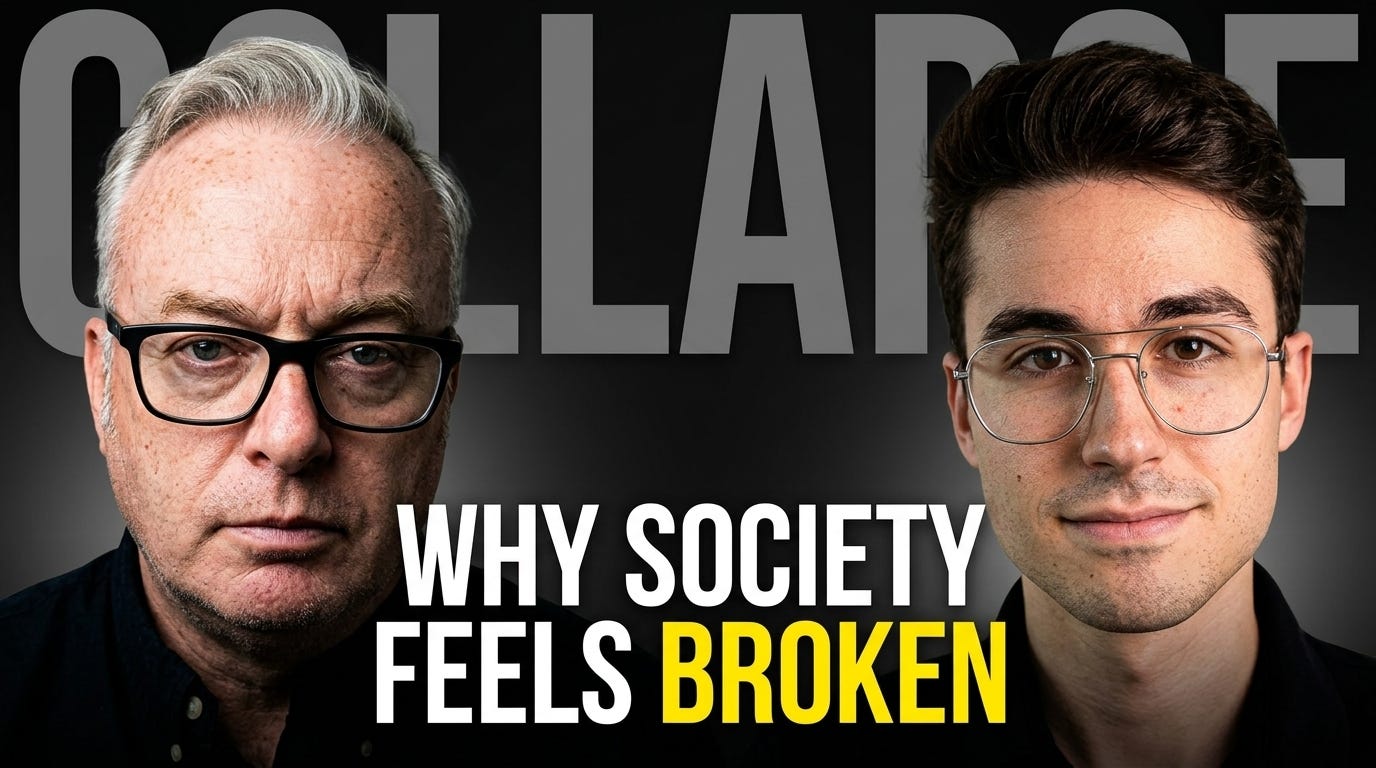
Are we at a turning point in civilization? Étienne-Alexandre Beauregard, in his new book Anti-Civilization, argues that our current trajectory might lead to significant societal collapse if we continue to prioritize individualism over communal values.
I had a chance to chat with Etienne, a young man of about 25 who has authored his third book, the first published in English.
He’s looking at civilization as a whole in a way that might leave many older Canadians scratching their heads. He rejects strident individualism, the idea that marriage should wait, the need for a collective life.
In essence, he’s rejecting much of the 60s ethos that has defined North American civilization for decades.
Understanding Anti-Civilization…
Étienne defines civilization as a collective agreement to repress individual desires for a harmonious society, inspired by sociologist Norbert Elias. However, he notes a reversal of this principle since the 1960s, where the focus has shifted to personal freedom at the expense of community norms.
“When we talk about individuals today, it’s about how can I be free myself without constraints.” — Étienne-Alexandre Beauregard
Speaking from the standpoint of Generation Z, Étienne reflects on how this shift away from community has left many feeling desocialized and disconnected.
“The amount of friends that people my age have, the frequency where they see their friends... all those things are really down compared to what our parents and grandparents used to have.”
Our conversation reveals alarming trends regarding social isolation among younger generations. With fewer connections and diminishing social groups, the essence of belonging seems to be fading.

From the Amazon description of the book…
In Anti-Civilization, Étienne-Alexandre Beauregard delivers a stark diagnosis: the dismantling of the norms that once shaped Western civilization has plunged society into a profound crisis, eroding the shared reference points that sustained it throughout the second half of the twentieth century.
Runaway individualism, he argues, has fostered isolation and identity-based tensions, dissolving the social contract and replacing it with a clash of impulses and competing subjectivities. As heirs to this culture of deconstruction―and deprived of stable cultural and moral anchors―Generation Z is living through the full consequences of this illusory freedom, a pseudo-liberation that leads not to fulfillment but to alienation.
Isolation and loneliness have been brought about by technology. In my humble opinion, we would all be much better off if I was still making 6 carbon copies on my manual typewriter.
Are you aware that The Governor of the Bank of Canada is in Beijing, China with Finance Minister Champagne. Since when does the Governor of the Bank of Canada get involved with politics, Mr. Carney should know this having been in this position himself. I think Mr. Macklem’s job should be on the line and I think Mr. Carney should stop acting as ‘all powerful’.