


After Chris D’Entremont crossed the floor in the House of Commons last November to leave the Conservative caucus and join the Liberals, there were been calls to ban this longstanding practice. After Michael Ma bolted from the Conservatives to the Liberals this week, those calls have been renewed.
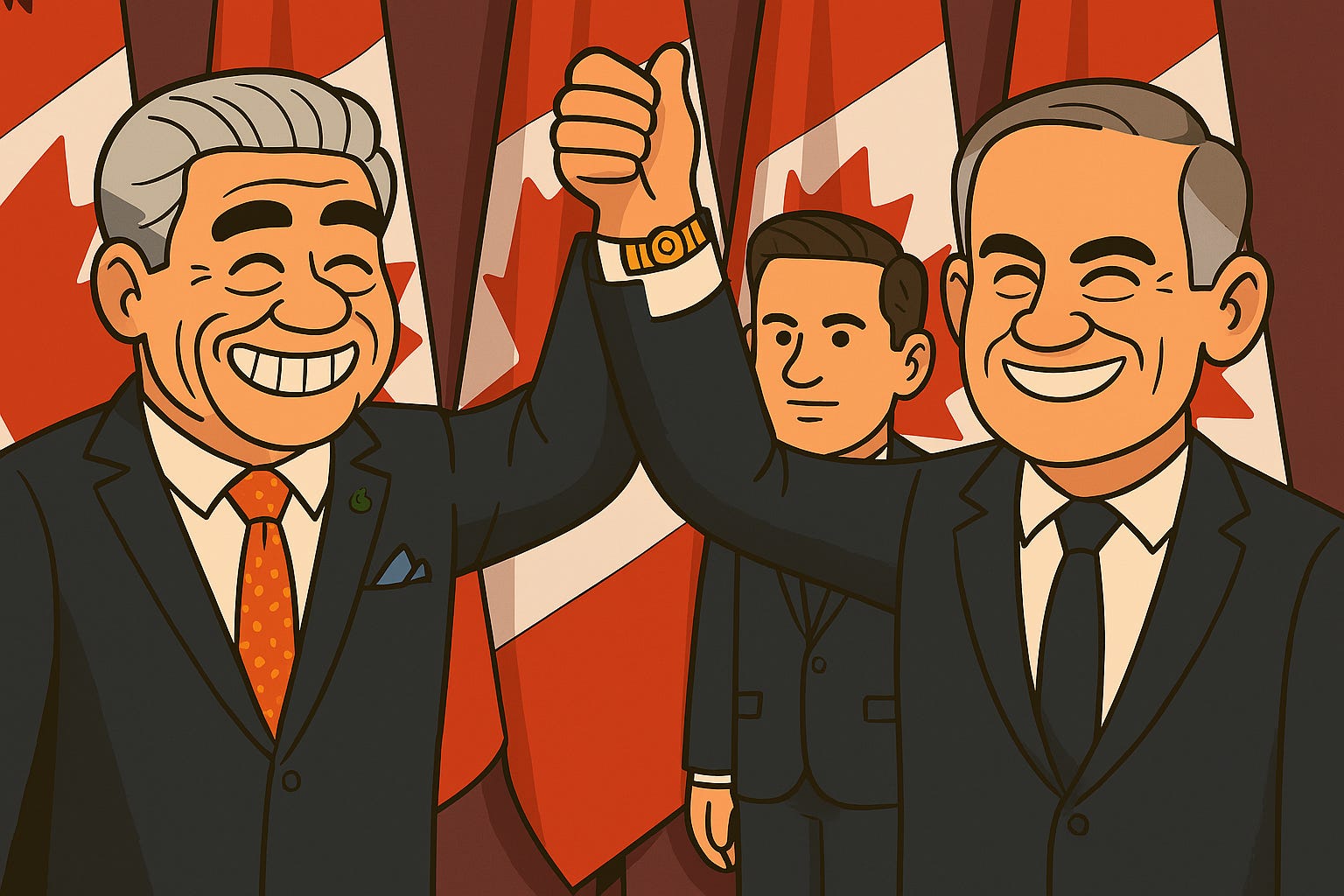
Crossing the floor to join another party has always been part of our system, even if it leaves a bad taste in the mouths of voters. Over the last month I’ve heard from people across the spectrum, including Liberals, who don’t think it should be allowed without a by-election or forcing the MP to sit as an independent.
Could we actually do that?
The answer is perhaps, though there would be problems, and I will explain in more detail below.
Breaking news in Ottawa from downtown Toronto…
First though, I do want to point out that once again, I was breaking news from downtown Toronto about what was happening in Ottawa. I do visit the nation’s capital when I can and should go more often, but I’m always in touch with various people who are in and out of the National Capital Region, as they call it, to bring you the best news on that front.
That’s why I was quick on Kirsten Hillman leaving as Canada’s ambassador in Washington, that Mark Wiseman was the man Carney wanted and then pointed out the strangeness of the fact that his name has been floated for days a breaking of all protocol rules. Some Liberals don’t think he will get the job at all, others think he is good, even some Conservatives sign his praises as long as the Carney government doesn’t adopt the Century Initiative.
I tell you this to point out that in supporting me, you get material the others often miss or are late to the game even though I’m a one-man band with a day job at the Toronto Sun – please read there.
On Michael Ma, I believe I was the first to report that it was Tim Hodgson who brokered the deal for Ma to join the Liberals. I know there are many people, including some I respect, pointing to China’s political interference, including in the riding or Markham-Unionville which the Hogue Commission on foreign interference documented, but I don’t think that’s the reason.
From what I can tell, Tim Hodgson and Michael Ma represent neighbouring ridings. They would see each other at community events and both men made their fortunes working for some of the biggest companies in Canada, the biggest companies globally.
At a certain point, it seems that Hodgson not only convinced Ma that the water was warm, and he should jump into the Liberal pool but that the Liberal pool was nicer.
I get all of the people upset at Ma going to the Conservative Christmas party, apparently not paying for his ticket, not fully participating in the Secret Santa with other MPs – but taking the gift – all while dancing up a storm and posing for a photo with Conservative leader Pierre Poilievre, but that ship has sailed.
As one source said to me, this appears to be more of a “Brookstreet Bros” move than anything else.
That’s how it happened but can we stop this from happening…
The question though is what we will do about it, and would it be constitutional.
One of the greatest Parliamentarians in the history of Westminster democracies, Winston Churchill was not only a rat, he was a re-rat. For those that don’t know, someone who switches parties is often called a rat, especially by those in the party the elected representative just left.
Winston Churchill was elected as a Conservative MP in 1901, but by 1904 was having serious issues with his party and by 1904 had switched to the Liberals. He stayed a Liberal for near 20 years before crossing back to the Conservatives.
The old line is to rat is one thing; to re-rat is another. That was Churchill.
Could we actually ban floor crossing though...
There are few countries that use our Westminster style Parliamentary system that we inherited from Britain that actually ban floor crossings. India, Pakistan, Malaysia, Indonesia and Bangladesh are some of the countries that ban floor crossing.
They also aren’t the most desirable democracies, and some of the ways they go about their bans may not sit well here.
Even the United States, which drew much from Britain but is very much a republic, doesn’t ban floor crossing. Members in Washington are free to change the parties that they caucus with if something changes.
Floor crossing has been banned in Canada in the past…
In Canada, two provinces have attempted to ban floor crossing - Manitoba and New Brunswick – but neither law stuck around long enough to be fully tested.
In New Brunswick the law banning floor crossing was passed by the PC government of David Alward in 2014 and repealed by the Liberal government of Brian Gallant in 2015. It required someone who left the caucus or party they were elected under to either sit as an independent or resign and force a by-election.
It was never tested in court.
In Manitoba, the NDP passed a law banning floor crossing in 2006. This law, which New Brunswick’s seemed based on, also required those who left their caucus or party to sit as independents or resign.
Here is how the old Manitoba law in effect from 2006 until 2018 read.
Member who crosses the floor must sit as independent
52.3.1 A member who
(a) is elected with the endorsement of a political
party; and
(b) ceases to belong to the caucus of that party during the term for which he or she was elected;
must sit in the Assembly as an independent and is to be treated as such for the purposes of this Act and all proceedings in the Assembly during the remainder of the member’s term.
In 2017, the PC Party of Manitoba kicked out MLA and former federal cabinet minister Steven Fletcher forcing him to sit as an independent. Premier Brian Pallister, another former federal Conservative, didn’t like that Fletcher had an independent streak and ordered him removed from caucus.
Given law against floor crossings, Fletcher was still banned from joining another party or even starting one of his own because he had been elected under a PC banner. In his view, the law violated his Charter rights to freedom of expression and freedom of association, and so he challenged the law in court.
Fletcher presented solid arguments on how the law restricted him and his activities but Justice Sheldon W. Lanchbery, a 2013 appointment by the Harper government disagreed.
In his ruling, Justice Lanchbery found that the law didn’t infringe on Fletcher’s freedom of expression or freedom of association and claimed that being free of party discipline might even make him freer.
Although s. 52.3.1 may be bad public policy, courts should not become the adjudicator of legislation or policy that is within the sole purview of the legislature. This is the very nature of parliamentary privilege. If a court were to do so, it would trample on the constitutionally protected separation of powers.
Now, that is one judge’s ruling and it may not have survived a further challenge but in 2018, the Manitoba government rescinded the law they had just defended in court so it never went further. A short time later Fletcher joined and then became leader of the now defunct Manitoba Party.
The ruling from Justice Lanchbery reads like a sound judgment, though one could easily argue the other side. What I have trouble believing is that the Supreme Court would have upheld Lanchbery’s ruling if it had been raised to that level.
My reasoning for that is that the initial ruling defers to the legislature and Parliament, something the Supreme Court is less inclined to do given they see themselves as the true rulers of Canada.
Polling shows support for a ban, also opposition…
A poll in 2018 on floor crossing by the Angus Reid Institute found that 42% opposed the idea, 41% supported it and the rest didn’t know.
The public would likely generally support a federal law against floor crossing if one were introduced, whether it would pass muster with the courts is another matter. The real issue is that both main parties, the Liberals and Conservatives have benefited from floor crossing. No matter what they may say when they are on the losing end of the bargain, they will want to use it in the future one day in the future.
The idea that either main party would legislate against this is doubtful.
Surely the main point is that an MP was elected by the constituents for the party/values he campaigned under .. if he subsequently chooses to change parties then all those who voted for him are no longer being represented by someone with their values … a by-election would be the fairest way to go… the people could then choose to follow the MP or vote for someone else to represent them…. An expensive proposition, I know, but certainly more democratic than having one's wishes hijacked without any recourse.
Yes it should be banned. The Majority of us are voting for a party not a candidate. When the candidate decides that they are switching sides they need to resign and a by-election should be triggered. The current system is unfair to voters and open to bribery and corruption. Time to end this practice.