


On Friday morning I woke up at an ungodly hour for no known reason. It was early enough that Mark Carney was hosting a news conference in Beijing, 13 hours ahead of Toronto, as I pondered why I couldn’t sleep.
Now, I love politics and I’m a political geek, but not enough of a geek to plan to get up in the middle of the night to watch the PM hold a news conference on the other side of the world.
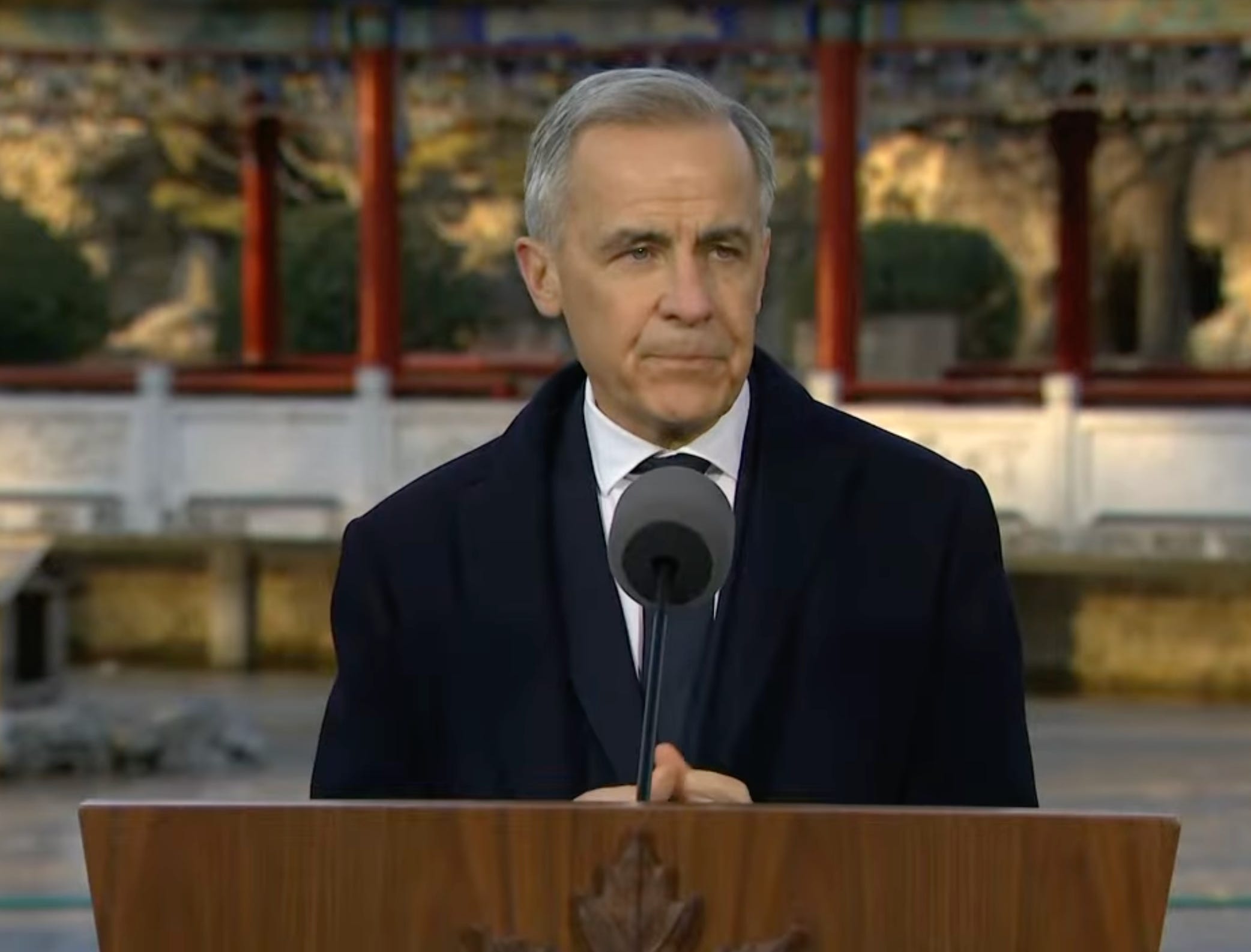
Still, as I watched the news conference, I was struck by how weak Carney and Canada looked. This is not what I want for my country, I want us to win, but this news conference was not a winning message.
I wrote about the deal for the Toronto Sun and if you haven’t read this column yet, you can do so here.
What I will do for you here is explain what this deal is, what the reaction has been like and why I believe this is the wrong move for Canada.
Let me be clear, this isn’t about whether we trade with China or don’t trade with China. It’s about how we trade with China, how close we get to Beijing and which relationships are prioritized.
What the deal is and isn’t…
This deal does not solve our trading problems with China, in fact it will create new ones. It’s important to look at the language that Prime Minister Carney himself used in outlining the “deal” such as it is.
First off, note that there were no Chinese officials standing with him for the announcement, there was no signing ceremony, it was Carney standing alone outside in a park in Beijing in the wind and freezing cold as one reporter put it.
“Canada has agreed to allow up to 49,000 Chinese electric vehicles into the Canadian market with the most favoured nation tariff rate of 6.1%,” Carney said.
Note the language, he said Canada has agreed. Now look at the language when he describes what China will do.
“By March the first Canada expects that China will lower tariffs on Canadian canola seed to combined rate of approximately 15% China is a 4 billion canola seed market for Canadian producers, and this change represents a significant drop from the current combined tariff levels of 84%,” Carney said.
You can watch the whole news conference for yourself if you don’t buy this, if you want to hear his tone. The same kind of language was used in the written documents posted to the PM’s website.
In the “new strategic partnership” on trade posted by Carney’s office the language is “Canada will” when discussing EVs and it is “Canada expects” when talking about China reducing tariffs.
There is also a joint statement put out by China and Canada, it never mentions canola, lobster or any other products China has tariffs on.
China did not participate in the announcement of this “new strategic partnership,” they did not commit but rather gave an expectation that they might do something and this new partnership doesn’t cover all of the Canadian products being tariffed by China.
There is no mention of pork which is subject to a 25% tariff and while lobster and crab are mentioned, it’s unclear on what this means for Canadian fish exports.
Why did Carney announce this deal…
PM Carney clearly needed a win coming out of Beijing. He was there for several days and had only been re-announcing previous measures.
Despite portraying himself as a man who understands global business, who could not only get a deal with Donald Trump - something he promised in the election and has failed to deliver - Carney also promised that he could expand Canada’s trade.
So far, that hasn’t happened.
He couldn’t come out of Beijing empty handed, he needed a deal, a win, or at least the appearance of one. The way this played out, Carney making the announcement on his own, the noncommittal language ascribed to the Chinese side, the lack of details, makes this look like we announced this on our own.
It looks like a one sided deal because it is one. Maybe China does eventually commit to all of this after making Carney and his team sweat for a bit, but this was an act of desperation.
Fortunately for Carney he has a compliant and mostly unquestioning media. I can’t believe the way most coverage has just glossed over the Canada expects part of this ordeal. The cheerleading from CBC and the loud applause from the pro-Beijing parts of our media is helping to drown out the possible problems ahead.
But first, the reaction…
Obviously, representing a province that relies heavily on the auto industry, Ontario’s Doug Ford was less than impressed. He said there was no consultation from the PM on allowing the Chinese EVs into the Canadian market and in his view it will be detrimental to Canada’s economy.
I will say that it’s more than a bit rich for Doug Ford to claim to be worried about the deal upsetting Donald Trump and the Americans. Beyond his ad campaign in the states, which I doubt was the real reason Trump became angry, Ford has taken great pleasure in irritating Trump for the past several months.
As for Trump, he said it was fine that Carney signed a deal with China.
Now, Trump says it is fine, but does anyone think that just hours after the deal was announced that he was briefed up on the details. His chief trade negotiator Jamieson Greer was briefed by Canada’s Ambassador Kirsten Hillman and Greer’s response wasn’t a positive one.
Both Democrats and Republicans in the United States are against Chinese electric vehicles. If the Democrats took control of the House and the Senate in the midterms and take the White House in 2028, the position on China is unlikely to change.
Remember, it was the Biden administration that first imposed their 100% tariff on Chinese EVs and asked us to do the same.
What is at stake as a result of this deal…
There is a lot of anger aimed at Ontario’s auto industry, and the billions promised to lure EV battery plants to the province. That includes the false belief that the government has already handed over billions and the EV industry is dying so the money is gone.
Combine that with the idea that we were taking on tariffs for canola to protect an EV industry in Ontario that doesn’t exist.
If either of those claims were true, this anger would be understandable, but those billions have not been handed over and China is a threat to the whole auto industry.
The incentives for attracting those plants are tax incentives, not a direct subsidy, meaning that the companies will get a production tax credit - a tax break - if they hit job creation and production targets. They are still paying tax, just less tax if they meet their targets which are set quite high.
Neither company will meet those targets meaning they won’t be getting the full tax break.
Secondly, experience in other countries shows that when Chinese EVs enter the market they replace all cars, not just other EVs.
As I was writing in the Sun the other day, Europe and Brazil are already feeling the pain.
Just 25 years ago, China produced fewer cars annually than Canada — about two million per year compared to Canada’s nearly three million vehicles at that time. Last year, China exported more than five million automobiles and in market after market they are rising in popularity and becoming dominant.
“China is plowing massive resources into becoming a global player in cars,” said Robin J. Brooks an economist and senior fellow at the Brookings Institute in Washington, D.C.
Brooks has been following China’s moves on auto exports, not just electric vehicles, and says what is happening in the EU is a major threat to European automakers. In Europe, the sale of Chinese vehicles has gone from 4% of all imported vehicles to 14% last year, and by some measures, more than 10% of all cars sold in the latter part of 2025.
“This is where the competitive threat for European automakers lies. China is flooding these markets with cars,” Brooks wrote.
He’s also looked at countries like Brazil where Chinese vehicles accounted for about 10% of that country’s vehicle imports in 2019 and grew to 36% in October 2025. Chinese EVs account for about 80% of that country’s EV market.
Allowing heavily subsidized Chinese vehicles into our market threatens all Canadian auto jobs.
I keep hearing people say, “Let the free market decide!” as if there is anything about how China operates that resembles the free market. Free trade only works between countries with similar economies, similar regulations and a belief in the free market.
China doesn’t qualify.
What will the Americans do…
On a whole host of issues, I’m getting the sense that the Americans are watching our behaviour and deciding we aren’t worth the effort. In my view, Trump is more likely to walk away from CUSMA at this point than renew it.
It’s true that it is in effect until 2036 and what is happening this year is just a review. He could still pull the Americans out of the deal, treaties only work as long as the parties abide by them.
Even outside of that, if China does what Carney was talking about and starts building auto parts here or even assembling automobiles, I think it will have a detrimental impact on our overall sector. The oft touted claim that parts go back and forth across the border seven times before being part of a finished car won’t be happening anymore.
The Americans will take fewer imports of assembled cars from us, production will slow and parts production will move south.
While back in 2000 we made close to 3 million cars, today we make just 1.3 million and if we continue down this path we will quickly be below 1 million. That’s a fear and a prediction, it’s not something I hope for.
If that happens to Ontario’s auto industry, we will see ripple effects across the country and even greater difficulty for other industries in exporting to the United States.
PM Carney said he wants to double our exports to China over the next decade. He may not have that long. Canadian exports roughly $600 billion CAD to the USA each year. We export about $30 billion CAD to China each year while importing $90 billion.
In trying to expand trade with China, we shouldn’t be doing it in a way that reduces trade with the United States, which is what I fear will happen.
Remember just a few years ago when China kidnapped two random Canadians living in China and held them as pawns just to punish the Canadian government?
Canada’s own domestic spy agency concluded that the Chinese government interfered in the 2019 and 2021 federal elections, aiming to influence outcomes by favoring candidates seen as pro-China
Carney/Liberals want to belong to China as a way to hate the US. It’s very important for the liberals to keep up the “hate America” programming to remain in power. I’m hoping Trump/US wakes us up.