


Today’s newsletter is brought to you by UNSMOKE.ca

Canada works best when rules make sense, but a growing provincial patchwork creates needless confusion. Today, depending on their postal code, adult Canadians face conflicting regulations and uneven access to legal smoke-free alternatives. The goal isn’t more rules — it’s better rules. Federal and provincial leaders must work together to establish one clear, consistent national framework that protects those underage, strengthens enforcement, and supports informed adult choice.
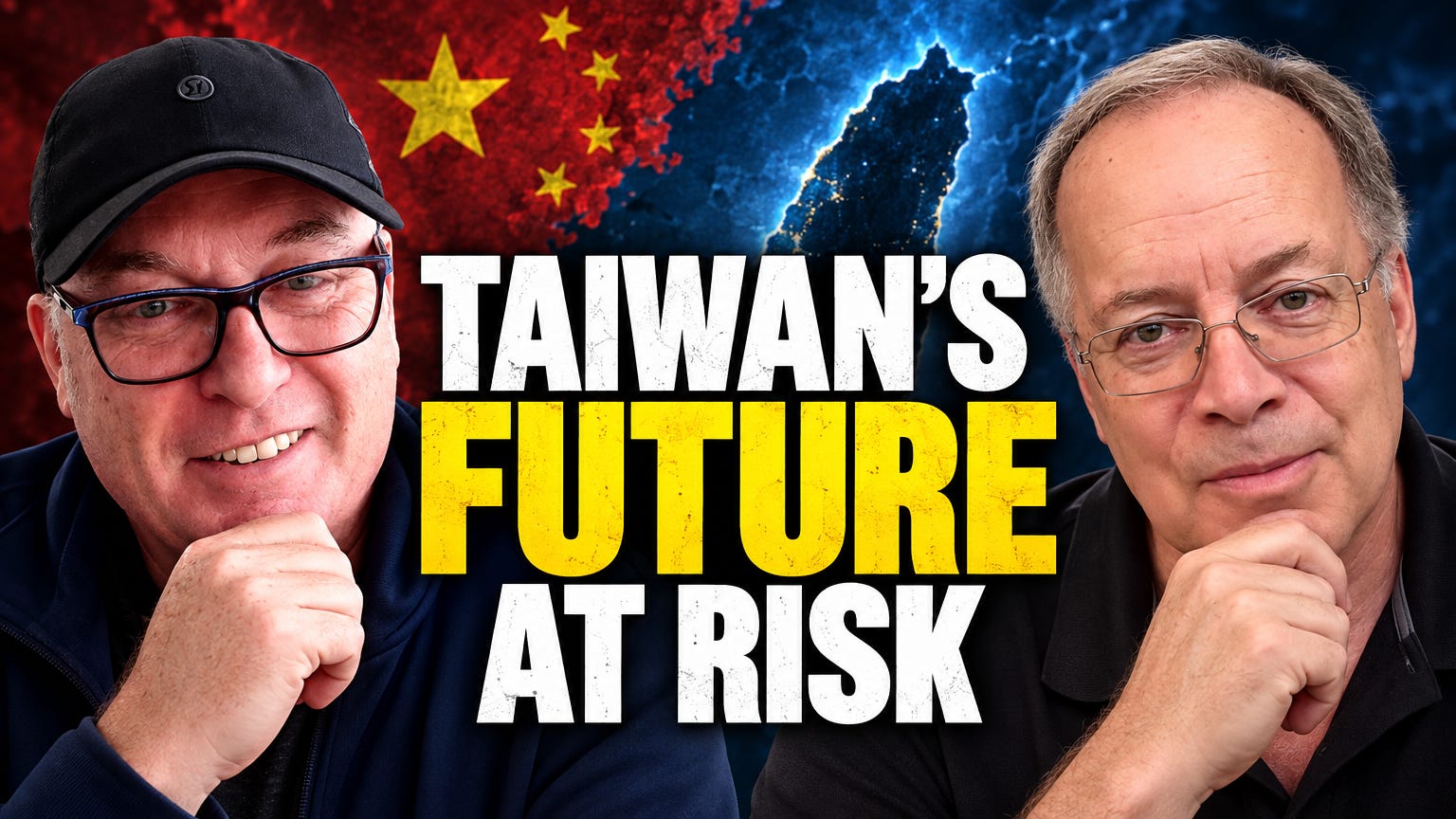
George S. Takach spent his professional career in the legal field. Since retiring a few years ago, he’s turned his attention to public policy.
He’s written several books now including two that deal in different ways with China.
His latest is the subject of this week’s Full Comment Podcast.

Inspired by Taiwan: Why Supporting Taiwan Matters for Global Democracy
Taiwan in my opinion doesn’t get the attention or support that it deserves. We used to call Taiwan, Free China, as opposed to Red China that was ruled by Mao and his successors.
As Western countries have tried to get closer to Beijing to take advantage of trading opportunities, they’ve been willing to sacrifice support for Taiwan as a cost of doing business.
I wish this wasn’t the case.
Taiwan may be the world’s most important geopolitical flashpoint that few people talk about. That’s the basis for my conversation with Takach.
Takach traces the island’s history from Indigenous rule through Japanese colonization, martial law and its rise into a democracy on par with Canada. He explains why Taiwan’s dominance in advanced chipmaking makes its security an economic issue for everyone, details China’s daily pressure campaign, and weighs whether Ottawa and Washington would truly defend it.
His case for supporting Taiwan rests on both national interest and democratic values.
Enjoy listening to the podcast below or wherever you get your podcasts including Apple and Spotify.
For those who prefer to read, there is an auto-generated transcription below.
From the official show notes:
Even as our prime minister seeks favour and greater bonds with Beijing, the communist regime continues to threaten to invade the free, democratic and economically vital republic of Taiwan, putting to the test where Canada’s values truly lie. Brian speaks with George Takach, author of the new book Inspired by Taiwan: Why Supporting Taiwan Matters for Democracy. He makes the case for why standing with the small island nation is even more vital to our interests, and the welfare of the world, than the temptation of Chinese market access. And he warns that signals of weakness from the West might entice China’s Xi Jinping to soon make good on his threats to invade Taiwan, surrendering an invaluable and potent Western ally to our adversaries. (Recorded July 29, 2026)
The transcription:
Brian Lilley: The future of Taiwan is one of the most important geopolitical questions of our day, but it doesn’t get the same headlines as the war in Ukraine, the Middle East, the fighting with Iran or the terrorists constantly attacking Israel. Yet it is a ticking time bomb in the Far East. China has its eyes on Taiwan, and Taiwan is hanging on by a thread — a democracy that doesn’t have as many friends as it would like, at least not ones who will recognize it and talk openly about their support.
Hello, I’m Brian Lilley and this is the Full Comment podcast. Today we talk to author George S. Takach. He is behind the new book Inspired by Taiwan: Why Supporting Taiwan Matters for Global Democracy. George, thanks for the time today.
George S. Takach: Great to be here. Thanks.
Lilley: A lot of people don’t think about Taiwan. It fades into the background, while China is high in people’s minds as they ponder important geopolitical questions. What made you say we need to talk more about Taiwan — or what we used to call, even if it was incorrect, Free China?
Takach: As you said in the intro, it is, in my view, one of the top three geopolitical hot spots in the world right now. It’s a small island. When I was there researching the book, I rented a car, and you can drive from the top of the island to the bottom in three and a half hours.
Lilley: I can’t get to Ottawa in three and a half hours, and I live in the same province.
Takach: Exactly. It’s a very small place, and about three-quarters of it is mountainous forest. If you’re southern Ontario-oriented, the effective space is Kitchener-Waterloo to Kingston, Peterborough down to the 401. But in that small space you have 23 million people and 160 universities and technical colleges. And they produce — this is what Taiwan is best known for — 96 per cent of the world’s highest-performing semiconductor chips, the logic chips. Without Taiwan, there’s no smartphone revolution, no laptops; this podcast wouldn’t be happening. Your cars increasingly use their chips.
At the same time, to your point about why China is upset with Taiwan, over the last 30 years Taiwan has created a very high-performing democracy. It’s ranked right up there with Canada in The Economist’s rankings. It has a civil society, gender equality, sexual diversity and the rule of law. As a recovering lawyer, I have to tell you its rule of law is very impressive.
This story has not been adequately told. In the book, I don’t just talk about the China-U.S. conflict and how it might affect Taiwan. The first five or six chapters are about Taiwan itself, because you have to be compelled by the story before you can understand the geopolitics.
Historical context
Lilley: Let’s talk about the history first, because the official policy of Canada, the United States and most of the Western world is that there is only one China. Yet while we don’t recognize Taiwan’s independence, we don’t necessarily recognize that China has control over it. Taiwan has been part of China for hundreds of years, ruled by the Japanese for a bit, and when Mao took over, it’s where the people who didn’t support the Communist revolution fled. But it wasn’t a democracy at first, was it?
Takach: Brian, I have to take issue with what you said about China ruling it for hundreds and hundreds of years. Let’s go back to the beginning. The Indigenous people of Taiwan are not ethnically Han Chinese. Think instead Austronesian — think Polynesian, think Papua New Guinea, Bora Bora, Fiji. Those are the original people of Taiwan, and they basically ran the place until 1624. The first outsiders to show up are actually the Dutch and the Spanish. The Chinese don’t really arrive until the late 1600s, and they don’t take much interest in the island for about a hundred years. The Qing dynasty takes a little more interest in the 1800s. But when China loses a war to Japan in 1894, as part of the peace deal it says, “Here, take what was then called Formosa. Take Taiwan.”
So, to your point, for 50 years, from 1894 to 1945, it’s ruled and governed by the Japanese — again, no Chinese connection during that half-century. Then, when Japan loses the Second World War, the KMT, the Nationalist government from mainland China, sends in a governor. They end up massacring 30,000 Taiwanese leaders — physicians, engineers, lawyers and so on. So the idea of Taiwanese independence is crushed again.
To make a long story very short — there’s a whole chapter on this in the book — when Chiang Kai-shek loses the civil war to the Chinese Communists in 1949, he flees to Taiwan with two million people: a million soldiers and a million family members. They set up the Republic of China, and Mao sets up the People’s Republic of China, the Communist version, on the mainland. Chiang doesn’t want the Communists to take over Taiwan, so he imposes martial law — the longest martial law in world history, 45 years. So there’s no democracy in the ‘50s, ‘60s, ‘70s and most of the ‘80s. Finally, in 2000, you get a democratic change of government to the DPP, and since then it has alternated with the KMT in effective, fair elections.
Lilley: That was part of my point — it didn’t start out as a democracy after the Chinese civil war.
Takach: Correct. And that’s part of what makes this fascinating. As you mentioned, they’ve gone from authoritarian, dictatorial rule to a democracy on par with Canada in very short order. That in itself is impressive.
Democracy versus autocracy
Takach: What it means today is that they are everything China is not. About 100 miles across the Taiwan Strait sits the behemoth: a dictatorial, single-party Communist state with no human rights, an oppressive regime — the autocrat of all the autocracies in the world. Across those 100 miles of water, you have a model democracy, a civil society and religious diversity. When I was there, I was blown away. You see a Confucian temple, then on the next block a Catholic church, then a Buddhist temple, then a Presbyterian church. Personally, I’m not religious, but as a quasi-sociologist I look at religious diversity to tell me how human rights are doing in a society, and I’ve never seen such religious diversity as in Taiwan.
Lilley: The official line out of the People’s Republic would be that they do have religious diversity — Catholic churches and others. The difference is that the Communist Party has to pick all the leaders. In the official Catholic church in China, the party picks the bishops, not the Vatican. They crack down on so-called house churches because they might teach something the party doesn’t like. China will claim these things and say, “Oh no, we’re just like that,” and they’re clearly not.
Takach: No, they’re clearly not. If you follow [NAME TO CONFIRM], the latest dissident to finally be released from prison in China — he’s now out of the country — and listen to his story, the bottom line is, as you said, the Chinese Communist Party cannot countenance any centre of power or thought other than its own. If that’s how they run themselves, that’s one thing. But to impose that on another country, particularly Taiwan, which is on the other side of the political spectrum — that’s where we, as Canadians, should take issue.
Canada, Taiwan and the one-China policy
Lilley: So why are we so tepid in our support of Taiwan? You went there; you did that wonderful driving trip with your wife, Barb, that you describe in the book. It makes me want to go to Taiwan. But why are Western politicians — Canadian, American, British, European — so reluctant to give a full defence of Taiwan? They’ll make statements about China not invading or intimidating Taiwan, but we don’t even recognize it as an independent country.
Takach: There’s a very interesting solution in place to what was a very difficult problem in the 1970s, when Communist China, still under Mao, decided it wanted to re-engage with the world. Through the ‘50s and ‘60s, Canada, the U.S., Europe — nobody recognized Communist China. Everybody effectively recognized Taiwan, then more commonly known as the Republic of China, which held the China seat on the UN Security Council, with the veto. But Mao told the world: “I want to re-engage, but here’s the deal. If you engage with China, you have to downgrade your recognition of Taiwan.”
That’s when Canada, the U.S. and virtually every other country said, “The commercial opportunities in China are so great, we’re going to recognize China — but we will not recognize China’s control over Taiwan, or its purported objective of achieving that control.” We came up with what we call our one-China policy: we understand that China claims Taiwan, but we don’t agree with that; we’re neutral on it. So our official embassy is in Beijing, but we have an office in Taipei. It’s not called an embassy, but there’s a lot of economic and people-to-people exchange. You won’t see a Canadian prime minister go to Taiwan, or even cabinet ministers. But you will see members of Parliament. Michael Chong, for instance, made an emphatic statement when he went to Taipei recently.
Lilley: Liberal MPs were supposed to be on a trip six or seven months ago, and they were pulled because it angered Beijing.
Takach: Yes, and that was a mistake of the first order. I think Carney learned from it. It happened at the same time he went to Beijing to try to reset the relationship with China. There happened to be four Canadian MPs in Taipei, two of them Liberals, as you say, and they were recalled — they packed their bags and returned to Ottawa because Carney said it would be confusing to the Chinese.
But to Carney’s credit, a few months later, in late April or early May, the Canadian naval vessel HMCS Charlottetown, after taking part in military exercises in the northern Philippines — really an exercise in thinking about the defence of Taiwan were China to attack it — sailed through the Taiwan Strait on its own. We’d never done that alone. It sent the signal to China that we very much still support free navigation through the strait and, indirectly, peace across the Taiwan Strait. So I think Carney learned from that first faux pas.
More recently, when the Chinese foreign minister was in Ottawa meeting our foreign minister, Ms. Anand — I wasn’t in the room, so I don’t know the exact words — I’m pretty sure he made a strong statement, and she pushed back and said, “Look, we can have commercial relations with you, China, but we are absolutely going to continue our relationship with Taiwan as well.” Hopefully we have an all-party consensus in Parliament that that’s absolutely the right track.
The semiconductor stakes
Lilley: More than 90 per cent of the world’s advanced semiconductors come out of Taiwan. Everyone thinks about computers when they hear about chips, but during the COVID-19 pandemic there was a slowdown in supply chains and getting vehicles became difficult. You waited months for certain vehicles because manufacturers couldn’t get the chips. If production of those chips were interrupted by an invasion or some other action by China against Taiwan, our economy would be in great difficulty. You mentioned earlier that it was the economic opportunity with mainland China that made people switch. Shouldn’t the fact that we’re now economically dependent on Taiwan blow away the idea that we should be neutral? Shouldn’t we be full-throated in our defence of Taiwan? We effectively need them.
Takach: The example you point to — the limited supply chain interruption for car chips and what it did to the auto sector — would be magnified many times over. Bloomberg has estimated that an interruption of chip production and supply from Taiwan would mean a 10 per cent hit to global GDP. That’s depression-level impact, not just a recession. In the U.S., it would only be 6.7 per cent.
Lilley: Only.
Takach: But still — depression level. So, Brian, you’re bang on. A number of countries, like the U.S., are quickly trying to recreate manufacturing capacity at home. But I can tell you from my trip — and there’s a whole chapter in the book on Taiwan’s economy — that TSMC has 16 campuses in Taiwan. Not individual buildings: campuses. Set that against Arizona, with three buildings. So the critical mass is going to stay in Taiwan.
My answer to your question is that we have to do both. We have to send a message to Xi Jinping, along with the other democracies, that taking over Taiwan is not on, and we have to help with deterrence. If you want peace, prepare for war — through deterrence — so hopefully we never have a war. At the same time, we should be able to sell low-tech commodities to China: our canola, our LNG and so forth. But we should not be buying their EVs, which is part of the Carney deal. That was a mistake. And we shouldn’t be buying high-tech products from any of the big autocrats, because there’s a data trail going back to those countries. So you can do both: support Taiwan and have limited types of trade with the autocracies.
Lilley: I think the ship has sailed on buying tech from China. Our phones, our laptops, so much of what we use to live the high-tech life comes out of China — perhaps powered by Taiwanese parts and technology, but built in China. I just looked it up: you mentioned the three buildings in Arizona. They’re going to build more, but that won’t come online until 2029. They’re doing some work in Washington State, San Jose and Austin, Texas. But you’re right, we’ll still be very dependent on Taiwanese technology. And the most advanced chips still come exclusively out of Taiwan.
Takach: I don’t want to get too technical, but the Arizona plant that’s come onstream is at what’s called the four-nanometre process level. The chips made in Taiwan are two-nanometre, which doesn’t sound like a big difference, but it’s about a 40 per cent difference in performance capability. So TSMC’s critical mass is still very much in Taiwan.
How did they get there? If you go to Taiwan, you must go to Hsinchu, their science city, about an hour from Taipei. Hsinchu is to Taipei what Palo Alto is to San Francisco. TSMC has its core factories and offices there, and there’s a museum devoted to their innovation. It highlights Morris Chang, who founded the company in the late ‘80s. His idea was: “I’m not going to design chips.” To be clear for listeners: the Nvidia chip is designed in California, the design goes to Taiwan, and TSMC makes the chip from that design.
And to finish the picture, the machines in TSMC’s factories — the most important machines in the world right now, at US$450 million each — are made, believe it or not, in the Netherlands. The country that gave us Gouda cheese, wooden clogs and tulips produces the most important chipmaking machine in the world. What I’m getting at is how global the supply chain is. It’s not just Taiwan; we also have to defend Europe through NATO.
To your narrow question — what has TSMC got that no one else has? They have focused only on manufacturing, and they’ve figured out how to do it with economics that blow away everybody else. In a nutshell, from a single silicon wafer — where the individual chips are made — they get yields of 85 to 90 per cent, when the rest of the industry is at 45 to 50 per cent. They have 75,000 engineers and a critical mass that knows how to get this done in a way nobody else can. The Chinese are desperately trying to catch up. I’d put them at least 10 years behind. You’ll hear stories about their advances, including Kimi and DeepSeek on the AI side, but they’re still well behind.
Lilley: I want to talk more about what would happen if China did act against Taiwan, but we need to take a quick break.
[Break]
China’s pressure campaign
Lilley: George, I want to ask you in a bit what really fascinated you about Taiwan, because, as you told me before we started, the book wasn’t originally called Inspired by Taiwan — it became that because of your trip. But first, what happens if China invades? How long before China acts? Most people believe President Xi will at some point try to take Taiwan by force or intimidation, some sort of leverage. What do you see coming, after your trip and all your research?
Takach: The first thing to understand is that China is already applying immense pressure on Taiwan. There’s a whole chapter toward the end of the book called “China’s Incessant Pressure on Taiwan.” Cyber attacks: China launches 2.6 million cyber attacks against Taiwan each day — not each week or month, each day. There’s economic coercion. There’s a wonderful story, with a good ending, where at the height of the pineapple harvest, particularly in southern Taiwan, China suddenly said, “We’re not buying any more pineapples.” All these pineapples were sitting there, and like all fruit, they’d go bad.
Lilley: I think a few of our canola farmers could relate.
Takach: So Taiwan went to Japan and said, “Do you like pineapple?” To make a long story short, they love pineapple, and today 95 per cent of Taiwanese pineapples go to Japan.
Something we haven’t explored, and I’m happy to talk more about, is that the book is now being read by a lot of Canadians not just for the Taiwanese story, but for lessons about what we’re starting to face with the Donald Trump presidency. We’re desperately looking for third markets. We need our own pineapple diversion story — whether it’s canola, pork, seafood, you name it. That’s how China applies pressure.
All of this pressure is being exerted, including what are called grey-zone tactics. Chinese warplanes fly all around the island, warships sail around it, and they hold live-fire exercises. I increasingly call them rehearsals for the invasion. Obviously, what China is trying to do with all these tactics is wear down the people of Taiwan and get them to throw in the towel.
What I found so impressive about the Taiwanese is that they’re pushing back. They have civil defence courses that families take together, with all sorts of training, not just first aid. In August, during their big annual military exercise, the country turns down its internet volume, as it were — a much slower internet. How do you survive when you don’t have full internet? Basically, they’re taking the lessons from Ukraine — how Ukraine has survived against all odds against a much bigger foe in Russia — and applying them.
I have to tell you, Brian, I was brought to tears multiple times during my interviews and by what I saw in Taiwan. Part of it was: if they can do it, we can do it against Trump. They’ve been at it for 75 years; we’ve only been at it for a year and a half.
Lilley: You mentioned those civil defence courses, and I suddenly remembered the stories of my grandfather being in the Home Guard in Britain during the Second World War: here’s a helmet and a flashlight, go get ready for the German invasion. It’s impressive.
Takach: That’s exactly it.
Identity and unification
Lilley: They’re willing to do it. But you write about how the people of Taiwan see themselves as Chinese — the polling shows that when asked how they identify, many say, “I’m Chinese.” Couldn’t Xi be trying to get Taiwan with a carrot rather than a stick? Couldn’t he be courting them, trying to make love instead of war?
Takach: This is a really central point. Xi Jinping makes the argument that if you’re ethnically Han Chinese —
Lilley: Taiwan is primarily Han and Hakka Chinese, plus the Indigenous groups.
Takach: Correct. The Indigenous share is very small, in the range of three to six per cent, and the rest is very much Han Chinese. Xi Jinping would like the world to think that everybody who is ethnically Han Chinese, in origin and ancestry, owes allegiance to Beijing. That’s like saying to Americans, “You’re English, so you should owe allegiance to London, to King Charles and the new prime minister, Burnham.” Americans would laugh and say, “Just because we speak English doesn’t mean we owe allegiance to England.” It’s very similar in Taiwan.
Even the language: yes, they speak Mandarin Chinese, but they also speak Taiwanese, which, when spoken fully and well, a Mandarin speaker from the mainland can’t understand. Most importantly, they speak democracy. They speak religious diversity, sexual diversity, the rule of law. Those values trump allegiance to a Han Chinese political idea.
They’re still ethnically Han Chinese, and they have great reverence for their ancestors. A lot of the cuisine is very traditional Chinese. But when you go to Taiwan, you see how their architecture is part Asian, part Western; their music, part Asian, part Western. They speak English in many circles. On some Taiwanese podcasts like this one, it’s half Taiwanese and half English, and they move seamlessly between the two — I mention one in the book. They’ve moved beyond a narrow sense of Chinese allegiance. The latest polls, including the voting, show maybe seven per cent want to unify with China, and 87 per cent absolutely do not.
Lilley: But if the leadership in Beijing were less autocratic, could those numbers change? Could people say, “They’ll let us keep our diversity, our civil society, the rule of law”? Essentially what they promised Hong Kong and then took away. Hong Kong was once a glorious place; I wouldn’t put it there now. If they had let Hong Kong flourish, they might have gotten Taiwan without a fight.
Takach: Absolutely, in the sense that the deal they made with Hong Kong — you remember the phrase “one country, two systems” —
Lilley: Yes.
Takach: — is precisely the deal they’ve been offering Taiwan: don’t worry, even though you’ll be part of China, you can keep your domestic institutions and way of life. But in Hong Kong, Xi Jinping has cracked down. So the Taiwanese don’t have to imagine a world where that promise is broken. They’ve seen it broken in Hong Kong with their own eyes over the last decade. So, to your point, there’s no hope of that happening.
What I say in this book and in my earlier book, Cold War 2.0, is that Xi Jinping is actually more autocratic than his three or four predecessors. If anything, he’s going the other way. And think about this: the current president, William Lai, is in his late 60s. He was in his early 30s when the struggle for democracy finally came to fruition. So the current leadership generation remembers the autocracy personally, not from dusty history books — they lived through it.
Would they go back to the system they worked so hard to give up? We visited two prisons, now museums, where the autocratic regime in Taiwan imprisoned and re-educated 330,000 dissidents, and another 3,500 were executed. So the current leaders, and civil society generally, understand it would not be at all conducive to what they’ve got.
Lilley: I wonder how long that survives. I’ve known many people who fled from behind the Iron Curtain — I’m old enough to remember it being up — and you hear their stories, then you talk to their children or grandchildren and they espouse views that would take people back to that. How do you go from fleeing communism to embracing full-on communism or a light version of it? It always boggles my mind.
Would the West defend Taiwan?
Lilley: George, I want to ask about the comparison with Ukraine, which you’ve mentioned a couple of times. Western leaders say they will defend Taiwan. You mentioned HMCS Charlottetown going through the Taiwan Strait. The Americans constantly say they’ll defend Taiwan. But will Western countries actually defend Taiwan if China invades? Because what we’ve done with Ukraine, in my view, is give them enough to keep going, but not enough to win.
Takach: One of the lessons we’ve learned as a community of democracies from Ukraine is that even before 2014, let alone the full-scale invasion in 2022, we did not give Ukraine enough military resources, particularly equipment, to build a self-defence regime that would make Putin wake up every morning and say, “Maybe not today.”
Thankfully, with Taiwan, until a recent Trump decision in the spring, the Americans have been selling sufficient weapons. And Taiwan has been making its own. They have their own fighter jet — it’s old, but still. They’ve built their own submarine. That’s fascinating when you think about Canada just announcing a German submarine as our new submarine. The Taiwanese built their own diesel-electric submarine. Granted, a lot of the software and the guts of it came from England. They have their own missile system and so on.
So they are learning the lessons of Ukraine. They’ve increased their military budget. They’ve expanded the major war-games exercise every August from one week to two, and brought thousands more people, including civilians, into it. They’re really muscling up.
But, to your point, they need friends. To your narrow question: I think Japan will absolutely be there for them, and its new prime minister, whom I’m a big fan of, has said so. I think the Philippines will be drawn in because they’re so interconnected. I don’t think South Korea will; they’re a bit like the Poland of Eastern Europe — they’ve got their own problems with North Korea. The big question is the United States, because HMCS Charlottetown is not going to do it.
Lilley: You mentioned Trump made a change in the spring. Explain that.
Takach: In the 1970s, as I described before the break, when the U.S. and other countries recognized China but kept up economic and people-to-people ties with Taiwan, the U.S. Congress passed the Taiwan Relations Act, or TRA. Under the TRA, the executive must sell weapons to Taiwan. Then Reagan — no shy wallflower — said, “I’m not even going to discuss these weapons sales with Beijing. This is between us and Taiwan.” So Taiwan has bought a lot of military equipment over the last few decades.
For the first time, after the Trump–Xi summit in Beijing in May, Trump, on the plane ride home, was asked whether he would approve the $14 billion worth of arms Taiwan is ready to buy. He said, “Well, I’m thinking about it. I’m going to use it as a negotiating chip with China.” That was a horrible position to take. It’s precisely what detracts from deterrence. If the Chinese start to see that the U.S. is not wholeheartedly supportive, that might be exactly what makes Xi Jinping say, “Maybe if I attack, the U.S. will sit on the fence.”
I’m hoping that coming out of the next meeting in September, Trump will say, “Yes, I’m going to approve that sale.” And particularly if there’s a change in the midterms in November, I think a Democratic-controlled House would force him to. So it’s not beyond correction, but it’s not helpful.
At the military level, I can tell you the U.S. military is still doing all the right things. But let me end on the Iran war. The use of precision-strike weapons, particularly the Tomahawk, and interceptors — the PAC-3 Patriot missile interceptors — means those are dwindling in supply, and the American military is even pulling some of them out of Asia.
Lilley: Yes.
Takach: So I’m hoping Trump can come to some conclusion on Iran without spending any more of those very precious munitions. I’m not a warmonger — I’m really not. It pains me that so much money is being spent on the military. But that’s what you have to do to preserve the peace. So let’s not squander it in the Middle East when what we really need is a proper deterrence posture around Taiwan.
The case for Taiwan
Lilley: Give me an argument. Tell the audience what you experienced in Taiwanese culture that would lead them to say, “George is right — we need to defend this country, these people, their democracy.” Give me the elevator pitch you’d use if you were stuck in an elevator with Donald Trump, Andy Burnham, Mark Carney and Emmanuel Macron.
Takach: The last chapter of the book is devoted to exactly that question, and I have about a dozen good reasons. I address both the people who care only about the national interest — hard power — and the people who care about values, because Taiwan resonates on both.
On national interest, I’ll be bare-bones and bare-knuckles: I don’t want 23 million Taiwanese working for the other side. I want them working with the democracies, on my team — Team Democracy. It’s the same with Ukraine. They now have the most powerful military in Europe. If Russia succeeds in taking over Ukraine, it will have the most powerful military in Europe aimed at the rest of Europe. So the national interest is that we don’t want all that tech-savviness working for Xi Jinping.
On values, I won’t go into the full storyline, but in the book I describe three instances where Barb and I were shown incredible kindness and generosity. The first time, I thought, that could happen anywhere. The second time, I thought, this is interesting. The third time, I said, something’s going on here. When I got back to Taipei, I asked a senior diplomat whether this was unusual. He said, “No, no. What you just described is Taiwan through and through. And you don’t get this in China. This is a product of 30 years of democracy and how they deal with other people.”
Only six per cent of the world’s population lives under a full democracy nowadays. We can’t afford to lose Taiwan. We want them in our community of democracies. And one day, just as Ukraine is now helping even the Americans, if we help Taiwan now, they’ll be helping us. So we have to support them for both national-interest and values reasons.
Lilley: The book is Inspired by Taiwan. George, you’ve inspired me to consider going to Taiwan and taking up one of the offers people keep approaching me with. You’ve also inspired me to read your previous book, which I didn’t know about: Cold War 2.0: Artificial Intelligence in the New Battle Between China, Russia, and America. Both of those are from Sutherland House, correct?
Takach: The first book is actually from Pegasus Books, out of New York, but the second one is absolutely Sutherland House, the finest publisher of non-fiction in Canada. Let me put in a plug for Ken Whyte and his fantastic team.
Lilley: Sounds great. You can pick them up wherever you get your books. George, thanks so much for the time.
Takach: Happy to be here. Cheers.
Lilley: Full Comment is a Postmedia podcast. I’m Brian Lilley, your host. This episode was produced by Andre Proulx. Theme music by Bryce Hall. Kevin Libin is the executive producer. Hit subscribe, share this on social media and tell your friends about it. Thanks for listening. Until next time, I’m Brian Lilley.