


We did a thing at Postmedia.
We actually asked people who are Indigenous what they think about Indigenous isses. This has annoyed some people, mainly White Liberals but there isn’t much I can do about that.
They’d rather we just ask chiefs and activists.
We didn’t.
Though I do have a great interview with Chief Aaron Pete from B.C. coming up, so stick around.
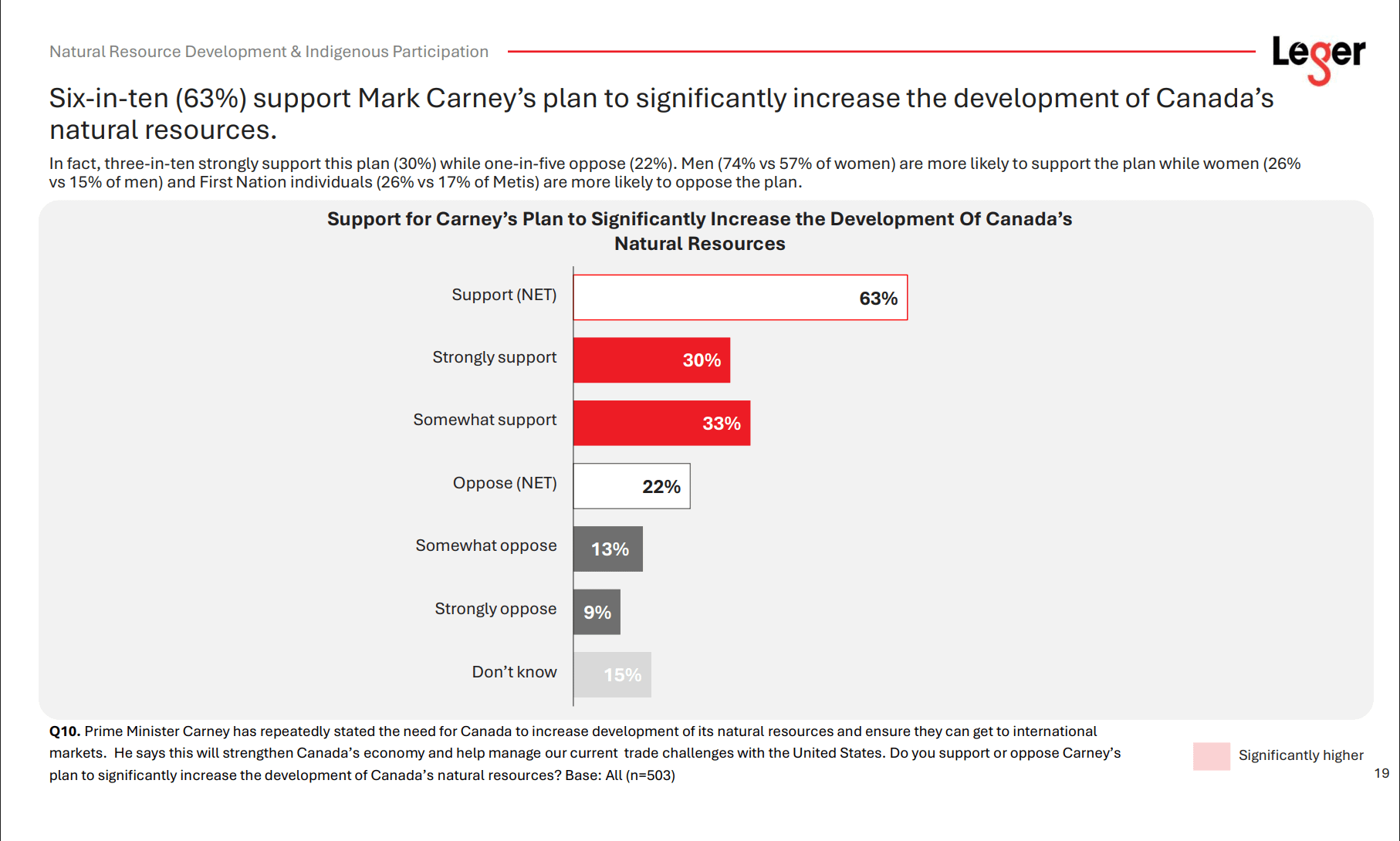
In partnering with Leger to poll Indigenous Canadians though, we found out that there are issues where their views deviate from the received wisdom of CBC. Did you know that 63% support expanding natural resource extraction such as oil, gas, mining and forestry?
You can read more on the poll here, but please enjoy my interview with Chief Aaron Pete, truly one of the bright young voices in Indigenous leadership.
This transcript was autogenerated and may contain errors, omissions, or inaccuracies. It has been edited for readability, grammar, punctuation, and style.
Talking Indigenous Policy with Indigenous Canadians
In Canada, we talk an awful lot about First Nations policy, but we don’t talk to First Nations people about it.
Hi, I’m Brian Lilley, political columnist for the Toronto Sun.
When we talk about policies that affect Indigenous Canadians, the people most often missing at the table are Indigenous Canadians themselves. Yes, we hear from activists. We hear from associations representing chiefs. But we don’t often hear from the people these policies are supposed to affect.
Across this country, when there’s a major issue underway, we poll on it. Companies commission polls, release polls and try to find out what the public thinks.
Do you support this policy? Do you support that one? Which is right? Which is wrong?
We know the answers down to specific demographic details. But when it comes to Indigenous policy, we haven’t really done that.
Recently, Postmedia teamed up with Leger to help correct that. We commissioned a poll of more than 500 people identifying as Indigenous from communities across the country. We weighted the results as best we could and asked them a series of questions.
Did you know that 63% of those surveyed support expanding resource development such as oil, gas, mining and forestry?
Based on the prevailing media narrative, you’d think the opposite.
What about the fact that 51% of respondents said they believe the federal government will protect their rights? Again, that runs counter to the narrative.
And on issues such as sentencing, race and land acknowledgements, the results don’t align with received wisdom either.
Forty-one per cent of respondents said land acknowledgements are overused and have lost their meaning. Forty-seven per cent said they still serve an important purpose.
The point is that Indigenous Canadians hold a much more nuanced range of views than many people assume.
As part of the Full Comment podcast, I recently interviewed several people about the poll. One of them was Chief Aaron Pete of the Chawathil First Nation, located just outside Hope, B.C.
The Trans Mountain pipeline runs through his territory. The proposed Pacific Trail pipeline would as well.
What does his nation think about that?
You might be surprised to learn that nobody in the media has really asked.
Here’s my conversation with Chief Pete.
Interviewing Chief Aaron Pete
Brian Lilley: Aaron, one of the things you try to do on your Bigger Than Me podcast is talk to people across political lines and develop a deeper understanding of issues.
I look at these survey results again, the Postmedia-Leger poll. It’s the first, or at least the largest, poll we could find examining the views of Indigenous peoples in this country.
There’s not a lot of polling done in this area, and I think the results will surprise a lot of people.
When you look at these findings, what do they tell you? Does broader Canadian society understand Indigenous culture? Do the media properly portray the diversity and nuance of views within Indigenous communities?
Chief Aaron Pete: No, I wouldn’t say they do a good job at all of representing the diversity of views.
You’ll often hear Indigenous people say, “We’re not a monolith.” This poll reflects exactly that.
When leaders from advocacy organizations such as the Assembly of First Nations speak, they’re not necessarily representing what frontline community members are worried about. They may believe they’re representing what chiefs want them to represent, but people in communities are often focused on much more immediate concerns.
They’re worried about poverty. They’re worried about how to rise out of it. They want quality education for their children. They want economic opportunity for their families.
Like every other Canadian, they want safe communities, better living conditions and a path to prosperity.
When we lose sight of that, when we assume First Nations are against all major projects or opposed to economic development, I think we miss the reality of what many First Nations communities are experiencing.
Brian Lilley: I remember speaking with Ellis Ross, the former chief from Kitimat who is now a Conservative MP.
He told me his band was originally part of Coastal First Nations, a group the media often turns to for comment as though it represents Indigenous opinion broadly.
I’m not dismissing them. It’s a legitimate advocacy organization. But that’s exactly what it is: an advocacy organization.
So many television reports portrayed it as though it were a specific First Nation rather than a political organization with a particular perspective.
Ellis said he eventually looked at what they were advocating and concluded it didn’t reflect his community’s views, so they left.
Journalists are under pressure. There are tighter deadlines and fewer resources than there used to be. Is it understandable that media outlets often call advocacy organizations first, or are there better ways to capture the diversity of opinion across Indigenous communities?
Political Leadership and Trust
Chief Aaron Pete: I think this polling work by Leger is reassuring because it’s providing a broader picture of how First Nations people actually feel.
I’ve also noticed that Prime Minister Mark Carney, Opposition Leader Pierre Poilievre and B.C. premier-designate Laurie Dirksen have all been making efforts to meet directly with rights and title holders and Indigenous leaders.
There’s a place for umbrella organizations, but whenever groups come together, a particular perspective tends to emerge.
That’s why I always come back to frontline communities and what people are actually living through.
If a First Nations leader isn’t talking about poverty, education outcomes, addiction or crime, I’m skeptical. Those are the issues that concern me because they’re the issues that directly affect people’s lives.
If someone can’t get out of poverty, they can’t reach their full potential.
That’s my focus.
Brian Lilley: One thing that stood out in the poll was how respondents judged organizations versus individual leaders.
Organizations such as the Assembly of First Nations generally received positive reviews. Yet when respondents were asked about individual leaders, recognition and trust levels varied dramatically.
Mark Carney, for example, received remarkably strong numbers despite not making Indigenous relations the centrepiece of his government in the way Justin Trudeau did.
What’s driving that?
Chief Aaron Pete: I think Carney’s focus on economic development resonates.
Like all Canadians, Indigenous people are looking at changes in the relationship with the United States and wondering how Canada adapts.
There’s optimism that he may be the right person for the moment.
There’s also significant interest in economic development opportunities.
Many Indigenous businesses want access to projects that create jobs, contracts and long-term wealth generation. Historically, those opportunities often passed communities by.
There seems to be excitement about economic reconciliation and ensuring Indigenous entrepreneurs have a chance to benefit directly.
Trudeau, Legacy and Trust
Brian Lilley: Another result caught my attention.
When respondents were asked how much they trusted various politicians to protect and promote Indigenous rights, Justin Trudeau received surprisingly poor results.
This is someone who dramatically expanded Indigenous spending during his time in office.
Why do you think so many respondents expressed distrust?
Chief Aaron Pete: Justin Trudeau’s legacy will undoubtedly include reconciliation. The amount of money directed toward Indigenous communities during his government is undeniable.
That said, I don’t know how many people closely follow the details of federal policy.
What I’ve heard from some community members is that there was often a disconnect between the media narrative and how they felt.
There were times when Indigenous communities were portrayed as strongly supportive of Trudeau when many people on the ground felt otherwise.
Economic Reconciliation
Brian Lilley: Economic reconciliation has to be one of the most important aspects of all this.
When you look at communities still struggling with poverty, resource development can provide a pathway forward.
Your community is along the route of both Trans Mountain and the proposed Pacific Trail pipeline.
How do people in your community view these projects?
Chief Aaron Pete: What’s shocking to me is how many communities that aren’t even near these projects were contacted by media organizations for comment, while communities like mine, directly affected by the projects, weren’t approached at all.
The Chawathil First Nation has experience with resource projects. We’ve participated in major developments and secured equity ownership opportunities.
The reality is that controversy attracts attention.
Success stories often don’t.
How often do we hear about a First Nation that has lifted itself out of poverty, reduced child welfare involvement and improved living standards?
Those stories rarely make front-page news, yet they are some of the most important examples of reconciliation succeeding.
Brian Lilley: Is your community supportive?
Chief Aaron Pete: Since these projects were announced, we’ve engaged extensively with our members through newsletters and community consultations.
To date, we haven’t encountered opposition to the Pacific Trail project from within the community.
The main question people ask is simple:
“Will our community benefit? Will our members get jobs? Will there be economic opportunities?”
If the answer is yes, support appears strong.
That said, we still need more consultation before submitting our final position.
My role isn’t to impose my own views. My job is to represent the wishes of our members.
Everything we’re hearing right now indicates broad support, along with a desire for more training, employment opportunities and economic development initiatives.
Progress on Reconciliation
Brian Lilley: How do you think Canada is doing on reconciliation?
Have we made significant progress, modest progress, very little progress, or none at all?
Chief Aaron Pete: I’d say progress has been highly uneven.
Communities that were organized and had the administrative capacity to pursue grants and government funding opportunities often did very well.
Communities that lacked those resources frequently missed out.
Since I became chief in 2022, our community has secured housing funding, obtained support from Indigenous Services Canada, renovated 45 of our 89 homes and brought our audits up to date.
We’ve taken advantage of opportunities that were available.
Other communities haven’t been positioned to do the same.
Canadians were broadly supportive of reconciliation in 2015. They understood the legacy of residential schools, the Indian Act, the potlatch ban and the Sixties Scoop.
They recognized the socioeconomic challenges facing First Nations communities.
But I think some of the conversation has moved beyond addressing those core socioeconomic realities.
I believe we need to return our focus to those fundamentals.
Land Acknowledgements
Brian Lilley: We asked respondents about land acknowledgements.
Forty-one per cent said they are overused and have lost their meaning. Forty-seven per cent felt they still serve an important purpose.
I have mixed feelings. Some acknowledgements feel meaningful. Others feel performative.
What’s your view?
Chief Aaron Pete: I’ve been skeptical for a long time.
The first time I heard a land acknowledgement during my undergraduate studies, it felt scripted and disconnected from action.
I understand the reasoning behind them, but I don’t find them particularly persuasive.
Personally, I’d rather see people focus on practical commitments.
If we’re beginning a meeting, I’d rather hear a commitment to protecting the environment, preserving ecosystems and making responsible decisions for future generations.
That would honour my ancestors more meaningfully than repeating a historical statement before moving on with business as usual.
I think land acknowledgements are gradually losing their impact.
Justice and Sentencing
Brian Lilley: We also asked Indigenous respondents whether a person’s Indigenous ancestry should be taken into account at sentencing.
Forty-five per cent supported it, while 41% opposed it.
Again, the public conversation is far more divided than many assume.
Chief Aaron Pete: I worked as a Native court worker for about five years. I also hold a law degree and an undergraduate degree in criminology and criminal justice.
The Gladue framework requires courts to consider the circumstances and history of Indigenous offenders.
For example, my grandmother attended St. Mary’s Indian Residential School. The abuse she experienced contributed to struggles with alcohol.
My mother was born with fetal alcohol spectrum disorder.
I was raised by a single mother with a disability and spent much of my childhood in poverty.
Those realities shaped who I became.
The purpose of Gladue isn’t to excuse criminal behaviour. It’s to help courts understand the circumstances that contributed to it.
I remember a case involving an Indigenous woman who had suffered extensive abuse as a child.
For the first time in her life, a judge acknowledged what she had endured and recognized how profoundly it had shaped her circumstances.
That doesn’t eliminate accountability.
She was still held accountable.
But it gave her an opportunity to be heard.
At the same time, I don’t think justice should become more lenient simply because someone is Indigenous.
If someone is vulnerable, struggling with addiction, mental illness or poverty, their story should be understood regardless of race.
My hope is that one day Indigenous people won’t be disproportionately represented among the most vulnerable in society.
The goal should be a system that recognizes and supports vulnerable people generally, while still ensuring accountability.
Brian Lilley: It sounds like what you’re calling for is more nuance.
Chief Aaron Pete: Exactly.
Brian Lilley: Chief Aaron Pete, thanks very much for your time.
Chief Aaron Pete: Thank you for having me.
Everybody has forgotten about the Royal Commission on the Aboriginal Peoples back in 1996 that was suppose to fix 1st Nations issues such as housing, infrastructure, healthcare, etc. Believe it or not, there was even supposed to be an Aboriginal Parliament. Guess what? Nothing happened and everyone forgot about it. What a gigantic waste of time and money. Here we are 30 years later and 1st Nations still don't have clean drinking water on reserves.
https://en.wikipedia.org/wiki/Royal_Commission_on_Aboriginal_Peoples