


Today’s newsletter is brought to you by Career Colleges Ontario.

Thousands of Ontario students are waiting for OSAP funding they were already approved to receive. Many of these students are partway through their studies and suddenly now cannot afford their books, rent, food, and other basic expenses.
With those payments now paused, students are struggling to make ends meet, with some facing the very real risk of homelessness.
Career Colleges Ontario is calling on the Ontario government to immediately release the approved funds for impacted students and provide clear communication on the future of OSAP eligibility.
Find out more at Career Colleges Ontario.
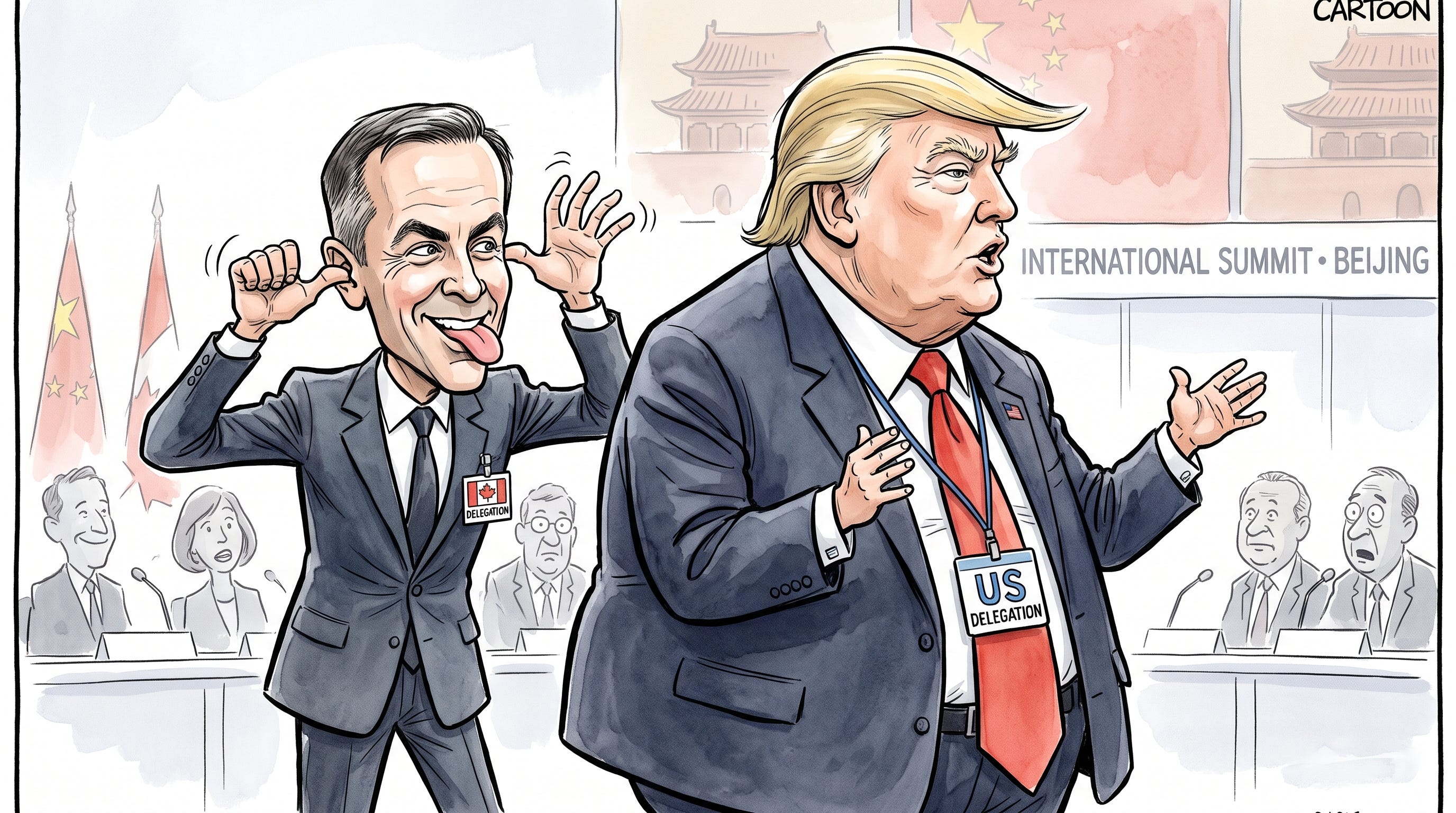
Mark Carney’s bizarre strategy, if you can call it that…
Our PM, the banker extraordinaire and the saviour of all the Canadas, Mark J. Carney is the main subject today and in particular, his interview with the New York Times.
Because of course while he was in Asia, he gave aa 22 minutes exclusive interview to the Times.
This was part of the New York Times Dealbook Summit and it’s actually quite fascinating. Which isn’t shocking, Andrew Ross Sorkin, who runs the thing, is a good interviewer.
He also has interviews with Elon Musk, Sam Altman, Palmer Lucky, Christine Legarde, Zohran Mamdani and more.
The reason that I think you should watch the whole interview with Carney, which I have posted below in video and transcript form is that it’s telling. Carney is clearly comfortable with his interviewer and wants to ingratiate himself to the NYT audience of warm, mushy liberals and so he lets his guard down.
As I write in my Toronto Sun column about the Friday meeting with Stellantis, the best way to save those auto jobs in Brampton is to get a deal with the United States. The problem is that as soon as Carney gets comfy, he starts taking pot shots at Trump every chance he gets which is what he does in this interview.
Speaking of those Stellantis jobs…
Had a great session on Batra’s Burning Questions on Thursday morning with Adrienne Batr and Alex Pierson talking about the bizarre auto jobs debacle with the Carney government. They say they want to save the jobs but threaten the company with lawsuits for EVERYTHING and not just the project in question.
They say they want Chinese EVs in Canada but then say they likely won’t be allowed in sensitive areas.
It’s madness.
A couple of housekeeping points before Carney…
Had a great interview today with Aaron Pete, Chief of Chawathil First Nation, a smart guy and host of the Nuanced Podcast. This interview will be part of the Full Comment Podcast episode that comes out on Monday.
I’ve written about Stephen Harper’s new book Here for Canada and I’m trying to work with his team to nail down an interview. As I’ve mentioned, I interviewed Harper about 10 times, at least that I can track, for radio, TV and print, when he was PM which I think is more than anyone else in the gallery at the time.
Hopefully we can set something up soon.
My interview with Warren Kinsella on his new book and documentary on Iran directing the protests against the West in general and Israel in particular has been the most viewed thing in weeks on our YouTube Channel.
If you haven’t watched it yet, check it out here.
Carney lets down his guard with the New York Times…
This is the Dealbook interview that I mentioned. It might make you mad watching it, but I do believe in understanding what the other side is saying.
Here is a transcript of the interview for those that prefer to read or want to pull some quotes.
Mark Carney at the New York Times DealBook Summit
Interview with Andrew Ross Sorkin
Edited transcript for readability, grammar, and clarity. Filler words, repetitions, false starts, and transcription errors have been removed while preserving meaning and tone.
Andrew Ross Sorkin:
Our next guest is Canadian Prime Minister Mark Carney. He joins us now from China, where he is attending the APEC meeting.
He spent more than a decade at Goldman Sachs and was Governor of the Bank of England through the financial crisis. He is, of course, at the centre of the U.S. trade war with Canada. His speech at Davos earlier this year was a watershed moment, when he warned of a “rupture” in the world order.
Prime Minister, thank you for joining us. It is late in China, so we appreciate your time.
Before we get into it all, can you bring us up to date? I know you met with the President of China yesterday and, I believe, spoke with President Trump today. Where do trade negotiations stand right now?
Mark Carney:
Andrew, I can report that trade negotiations are going exceptionally well. We reached an agreement that reduced tariffs and resolved more than 90 per cent of trade irritants.
Of course, I’m speaking about our trade negotiations with China.
They’re very professional. They move forward in a linear fashion, and it’s all very rational.
If you’re asking about the United States, we continue to have a series of issues there. There is a very good trade arrangement that is possible. We had one under the USMCA, and there’s one under the new trade policy that is possible as well, but we’re not there yet.
Strategic diversification
Sorkin:
Can you explain how you now think about Canada’s relationship with China versus its relationship with the United States? If we’d had this conversation a year or two ago, you would have called the U.S. our ally and described China quite differently.
Carney:
The United States remains our ally. That has not changed. We are NATO allies and partners across a wide range of areas.
What has changed is the trading relationship.
The second thing that’s changed is that both the United States and China, over the last 18 to 24 months, have used economic integration as a weapon. The U.S. has done so through tariffs; China has done so through critical minerals restrictions. There have been other examples.
We’ve seen financial systems used against Russia through sanctions as part of the response to the unjustified war in Ukraine.
What countries, including Canada, have learned from this is the importance of understanding strategic dependencies. Where do you need to diversify? With whom do you need to partner in order not to be coerced or subordinated?
This extends beyond traditional concerns such as energy, food security and defence. It includes intelligence infrastructure, space, critical minerals and other strategic sectors.
Our trade strategy with China, the United States and everyone else is driven by diversification and reducing dependencies so that we are more sovereign. Ultimately, that’s what’s driving the strategy.
Sorkin:
Do you think the U.S. midterm elections changed anything regarding trade or your view of the United States, given comments President Trump has made about Canada becoming the 51st state?
Carney:
You have to take the president’s comments in the round. We had a very good discussion this evening, so I’ll leave it at that.
But has it changed my view? No.
What changes views are policy decisions that are taken and maintained over time. Until policies change, it’s difficult to change your assessment. That’s simply the reality.
Canada’s approach to allies
Sorkin:
A difficult question: Do you trust President Xi more than President Trump?
Carney:
We look for alignment and we trust alignment.
Sorkin:
Do you see yourself aligned with China now? After all, China jailed two Canadians.
Carney:
Exactly. We’ve had fundamental issues with China in the past. President Xi and I have had very frank discussions about those issues, about how to operate going forward and about the limits of the relationship.
Let’s put Canada-China integration into perspective.
We trade agricultural products. Most of the recent liberalization has involved agricultural goods. We trade some conventional energy. We import manufactured products from China.
What we do not do is share any aspect of our intelligence infrastructure with China. None.
That’s a huge difference compared with the United States.
The exposure Canada has to China, particularly in dual-use sectors, is minimal. It’s certainly dwarfed by the exposure of the United States.
I find the focus on Canada’s relationship with China somewhat overblown. What we’re doing is normalizing a relationship that had fallen to a very low level because of the issues you referenced.
Compared to other advanced economies, this remains a relatively limited relationship.
Economic sovereignty and diversification
Sorkin:
President Trump recently said Canada is “willing to give us anything” and that the U.S. has “all the cards.” What are Canada’s cards?
Carney:
First, everyone else in the world wants to deal with us.
Second, we have the strongest fiscal position in the G7 by far.
We are at the beginning of an investment supercycle. We’re an energy superpower. Job creation is growing at roughly twice the U.S. rate. Foreign investment per capita is tracking at roughly twice the U.S. rate.
Our non-U.S. exports are now the highest share of total exports they’ve been in 40 years.
So yes, we have a lot of cards.
I’m not saying the transition away from an economy highly integrated with the United States is easy. It isn’t.
But another card we have is a population that is remarkably united, for a democracy, behind what we’re trying to accomplish.
Sorkin:
Polling suggests Canadians are wary of deeper ties with China. Only 14 per cent support closer trade ties with China, while 58 per cent support closer ties with Europe. What do you make of that?
Carney:
We’re pursuing the closest economic partnership possible with Europe without becoming a member of the European Union.
We’re in the process of becoming an associate member of the European Union. We already have a deep free-trade agreement. We’re now extending cooperation into research, people-to-people ties, infrastructure, regulatory alignment and defence cooperation.
For many defence purposes, we’re effectively treated as European.
Reducing strategic risks
Sorkin:
Why is that so important if Canada already enjoys many of those benefits?
Carney:
Because we’re building something that goes well beyond a conventional trade relationship.
Europe remains the world’s second-largest economy, and Canada has historically been under-penetrated there because we focused so heavily on the United States.
The United States changed its trade policies; we’re responding by diversifying.
There’s another factor. The “rupture” I described involves the weakening of international rules and institutions. You can’t rely as much as you once could on WTO rules or global standards.
Deeper integration with a single partner creates significant risk.
Diversifying with Europe, which is like-minded, rule-based and complementary to us in areas ranging from space to critical minerals, is an obvious advantage.
It’s not our only strategy, but it’s an important element, and it’s strongly supported by Canadians.
Technological autonomy
Sorkin:
One area you’re discussing with Europe is satellites and space infrastructure, partly to avoid dependence on Starlink. When you choose alternatives, aren’t you risking being left behind by a company that may continue improving faster than anyone else?
Carney:
That’s a fair question.
We’ve seen situations, including in Ukraine, where dependence on Starlink or Starshield has shifted from being a major advantage to becoming a vulnerability.
Once you’ve seen that happen, especially given the integration of space technology, defence systems and drones, you can’t ignore it.
The question Canada, Europe, Japan and South Korea are asking is whether we can build either a sovereign capability or a redundant capability.
We’re not trying to build a global retail communications platform. We’re asking a narrower question:
How do we protect the Arctic and the High North?
Whose system are we going to rely upon? And when a crisis comes, who decides whether that system stays on?
These are low-probability but high-impact risks. Some of our allies have already experienced them, and we’re adjusting accordingly.
Long-term trade strategy
Sorkin:
Does diversification become harder over time? What happens if China invades Taiwan, for example?
Carney:
The key issue is determining who you’re partnering with and in what sectors.
If we’re selling canola to China, that doesn’t compromise Canadian sovereignty. It’s basic agricultural trade.
If China were operating our military satellite network, that would be a different matter entirely.
We are far more sophisticated than that in deciding who our partners are and where alignment exists.
Of course, there is always risk. Governments change. Priorities shift. Alliances evolve.
That’s why you build redundancy.
And to be clear, this isn’t ideal.
Insurance always carries a cost.
It would be simpler if the Western alliance remained sufficiently cohesive that everyone could simply choose the best technology available. But after Greenland, after the “51st state” rhetoric, after Ukraine and the Starlink issue, it would be irresponsible to assume that level of certainty still exists.
That’s a difficult reality, but it’s reality.
Diplomacy and hedges
Sorkin:
Suppose a new U.S. president is elected in 2028 and says, “Let’s go back to being close allies.” What do you say?
Carney:
I’d welcome that and look forward to working with them.
But it will take action, not merely intent.
I can’t put this genie back in the bottle.
There are many areas where Canada and the United States cooperate deeply. Arctic defence, NORAD, NATO, national security and a still very open trading relationship.
But there are dependencies it would be unwise not to hedge against.
And once you put those hedges in place, the question becomes whether you remove them simply because the market reprices, or whether you leave them in place until you’re truly convinced conditions have changed.
I suspect countries will keep those hedges in place for some time.
Auto trade and competition
Sorkin:
Canada recently reduced tariffs on Chinese-made EVs from 100 per cent to 6 per cent. What’s your long-term view of Chinese vehicles entering the North American market?
Carney:
A couple of points.
Before Canada imposed punitive tariffs matching the United States, we were importing about 49,000 Chinese vehicles annually.
When we reduced tariffs, we told China that the lower tariff would apply only up to that same 49,000-vehicle volume.
Anything above that faces the higher tariff.
In effect, we’ve capped imports from China at less than three per cent of our market.
Ironically, before the tariffs, nearly all those imports were Teslas built in China. In fact, I owned one myself.
Sorkin:
You don’t anymore?
Carney:
No. I thought I’d get better resale value than I did.
But honestly, I got a new job and I’m not allowed to drive anymore.
So that’s the real answer.
The larger question is what happens to the North American auto market.
Neither President Xi nor I believe North America’s auto industry will remain globally competitive if it becomes fragmented and fully repatriated into the United States.
Canadian and Mexican parts, suppliers and production networks remain important competitive advantages.
Another major factor is electrification and the shift toward connected, AI-driven vehicles.
Let’s state the obvious: North America is well behind China in that transition. Europe is behind as well.
We’re spending far too much time fighting a trade war over autos and not enough time asking where the industry is headed and how we can pool our resources to compete.
We’re eager to do that, but we need a willing partner in the United States.
Closing thoughts
Sorkin:
One final question. What is President Trump like in private compared with his public persona?
Carney:
He’s very different in private.
He’s personable. It’s difficult to become president if you’re not.
He also listens more than people might think. He’s genuinely interested in hearing your views.
The conversations are direct.
But at the end of the day, we’re discussing whether there’s a deal to be made. Any agreement has to be in Canada’s interests.
We’re moving closer, but we’re not there yet.
Sorkin:
What’s the timeline?
Carney:
Frankly, it should have been completed six months ago.
But we’re not going to sign something that doesn’t make sense for Canada.
And we’re busy.
We’re catalyzing roughly a trillion dollars in investment over the next five years. We’re on track to achieve that.
We’ve just signed two trade agreements in the last two days. We recently signed agreements covering approximately 700 million people and concluded a deal with the Philippines. We’re working toward a deal with India in the coming months.
Canada already has free-trade access to roughly two billion consumers outside the United States, and we’re on track toward three billion.
We would like a deal with the United States.
But if the United States doesn’t want one, we have plenty of work to do elsewhere.
Sorkin:
Prime Minister, thank you very much for joining us.
Carney:
Thank you.
[Applause]
Sorkin:
We’re going to take a quick break. Grab a coffee, make some friends, and when we come back, David Ellison.
To quote the Good Book, after listening to the PMMC interview…Jesus wept.
Politicians have learned to call their spending of the taxpayers' money ‘investment' or 'free' which are propaganda slogans to win over the public. Government needs to get out of the way and let the private sector flourish.
"As I have often said, governments don’t produce economic growth, people do."
Ronald Reagan