


Today’s newsletter is brought to you by Unfreeze Ontario
Property taxes should be fair for everyone.
We’re calling on the province to restore regular property reassessments, which have been frozen since the pandemic.
Frozen assessments don’t freeze tax bills. They affect how the bill is divided, leaving some homeowners and businesses paying more while others pay less. A regular reassessment cycle from the province is a straightforward way to restore fairness.
To learn more, visit UnfreezeOntario.ca.
Beating back the separatist coalition…
Stephen Harper has a new book coming out this week.
It’s called Here for Canada: Memoirs of the 22nd Prime Minister and it’s out on November 3, yes, US midterm day, but you can pre-order it now if you want.
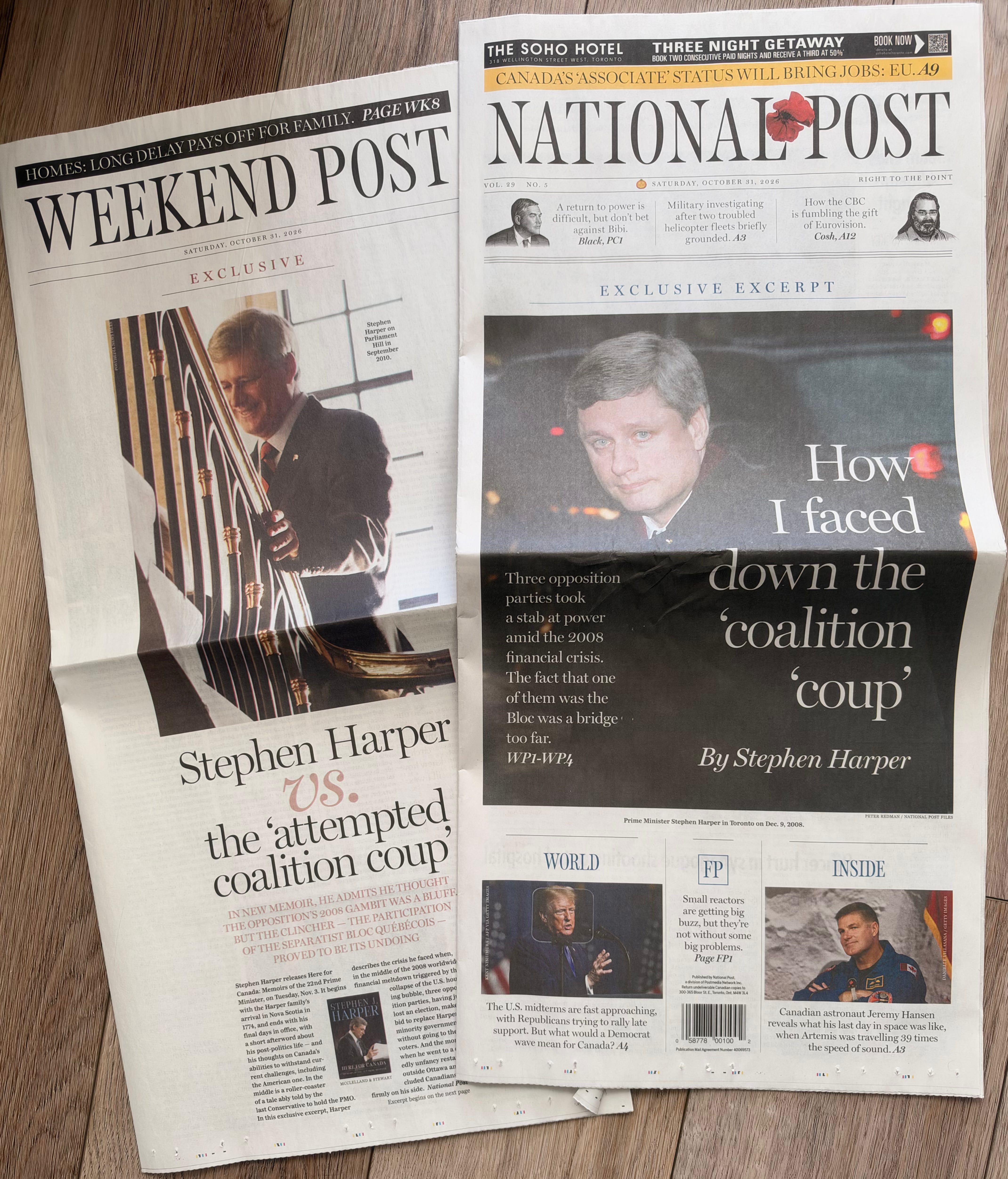
This morning I had the pleasant surprise to find out that National Post has an excerpt and it’s focused on a time I remember well.
The attempt by the Liberals to form a coalition with the NDP and Bloc Quebecois to seize power shortly after the 2008 federal election.
Back in 2008, I was the Parliamentary Bureau Chief for Newstalk 1010 in Toronto and CJAD 800 in Montreal. The election was on October 14 that year after being called 37 days earlier on September 7.
It’s what happened in between that made the election volatile and set the stage for what followed.
On September 15, 2008 Lehman Brothers, one of the pillars of Wall Street collapsed. The financial crisis went from something that was covered in the business pages to something that dominated the news.
The state of the economy dominated the election campaign as people watched their portfolios shrink. When Harper suggested in an interview with Peter Mansbridge that there were good buying opportunities out there, he was vilified by the media.
One journalist even set up a Harperdex showing what would happen to your money if you had invested in the stock market when Harper made those comments. Of course at first it showed a loss, but anyone who had followed the advice was doing quite well within the year.
Anyway, during the campaign I few out to Victoria to interview Harper in a bland conference room in a waterfront hotel. I asked him a lot about the economy during that interview, he focused in time and again on offering a steady hand in turbulent times.
“At a time like this, you better have a government that’s focused on the economy, that has a plan, and that will make sure it gets the economic fundamentals right: lowering taxes, not raising them, keeping prices down and interest rates down, not pushing them up, making sure we make investments in jobs, not panicking and blowing the governments’ budget way up in some way that we know we can’t afford, and that’s, those are the very fundamental choices in this election.”
The election was just over a week later, the day after Thanksgiving, and while the mood in Calgary at the convention centre was buoyant, the Conservatives only won 143 seats, 12 shy of the 155 needed for a majority.
The shocking move that saved the day for Harper…
While the Conservatives gained 16 seats in the election, it was still a minority. Meanwhile, the Liberals went from 95 to 77, the Bloc from 48 to 49, the NDP from 30 to 37.
It was a pretty strong majority, but when Harper and his finance minister, Jim Flaherty, released the fall economic update on November 27, the opposition decided to try and seize power. In the book, Harper describes how he met with each of the opposition leaders beforehand and they were all a bit off.
Even Jack Layton, who Harper said was always trying to offer ideas or horse trade, was reluctant to say much of what they were looking for.
Harper thought they were going to try and defeat him and force an early election. Instead, as he would find out on December 1, they were doing something much different, forming a coalition in a way that could give him the upper hand.
Later that day, the other parties made their announcement on the coming coalition. Just outside my office, a few staffers had gathered to watch it. After a few minutes, I stepped out to join them. My jaw literally hit the floor.
There they were, sitting in the National Press Theatre. Mr. Dion, who had just suffered one of the worst defeats of any Liberal leader in history, telling the country he would be the prime minister. Jarring, but what did you expect? Mr. Layton, playing the third-party kingmaker. A bit less jarring perhaps. And Mr. Duceppe, grinning like a Cheshire cat, an apparent co-equal in the grand project. At that point, with that image, I knew this was a fight I could win.
Harper describes in the book how he went into Question Period on December 2 and let Stephane Dion have it. I dug this video up on the House of Commons website, it’s something to see.

I’m looking forward to reading the whole thing and ordered it already.
One of the things that sticks out most in my mind from those days is how the Parliamentary Press Gallery was nearly entirely against him on this issue. Some might say that was always the case, and Harper does take shots at the media in the book, but this was media acting as opposition on a grander scale.
I remember my colleagues defending the idea of a coalition propped up by a separatist party. They would go out of their way to say it was a Liberal and NDP coalition and the Bloc wasn’t really part of it.
Of course, without the Bloc, the coalition could not work and most Canadians saw through that BS.
Harper describes how he weighed his options from letting the coalition take over and calling an early election. He had good reasons that I’d never heard before for rejecting those ideas before turning to the only option that he thought made sense.
That left the only viable scenario: to ask Governor General Michaëlle Jean to prorogue Parliament. The idea had come to me first (and virtually simultaneously) from two sources. One was John Baird. The other was a longtime Conservative organizer in Ottawa, my close friend Colin McSweeney. The rationale for this was compelling. It would delay a confidence vote until we could present our budget. Then, if we were to be defeated in the House, it would be on our full economic plan, on which work was already under way. Defeating us on substantive economic policy would only have strengthened our hand. Added to the ugly motivations of the opposition coalition, it would have put us in an almost unassailable political position.
I had never heard that Colin McSweeney was one of the people that advised Harper on this. Strangely, Colin McSweeney is a good friend of mine as well and he’s never told me this or taken credit for the idea.
Despite prorogation being controversial with the media, the ones that liked the idea of the coalition, the ploy worked. Flaherty delivered his full budget on January 27, 2009 with money for job training, supports for businesses, changes to the EI system and the home renovation tax credit - all ideas meant to boost the economy.
Stephane Dion resigned as Liberal leader in the face of the coalition falling apart and Michael Ignatieff took over. Another future Liberal leader was also being showcased at this time, though few would have predicted what would come.
Harper and Flaherty received a lot of praise for their handling of the economy through the financial crisis. As they were appointed to boards and committees to guide the G20 response to the crisis there was another man working with them getting a lot of praise.
Mark Carney.
Can’t wait to see what Harper’s book has to say about our current PM.
Why do we, the Canadian people NOT have a voice in our current government’s aggressive pursuit of EU membership??
I do not ever remember hearing this view or claim in any of his speeches prior to the election??
"Harper and Flaherty received a lot of praise for their handling of the economy through the financial crisis"
To be fair, BOTH Harper and Carney took credit for navigating Canada thru the 2008 financial crisis. Not true. OSFI was established in 1987 and laid the groundwork to regulate our banks strictly. That's why none of them collapsed during the 2008 financial crisis. The regulations were well in place before Harper or Carney came along.