



We’ve learned more about Mark Carney’s immigration plans from the New York Times than from the Canadian government, because apparently that’s where our prime minister prefers to update Canadians.
This isn’t a new interview. It’s the same one he did two weeks ago when he was attending the United Nations. The first few days, the Canadian coverage of that was all about the “invasion” scenario he laid out for them.
Canadian media took to that like a kitten to catnip.
There was also the issue that I was writing about: Carney’s determination to end the U.S. dollar as the global reserve currency.
But in the middle of the interview were three questions from Kathleen Kingsbury, the opinion editor at the Times, about immigration, including when Carney planned on reversing his immigration cuts.
There was back-and-forth and some explaining, but below are the last two paragraphs that some Canadians picked up on earlier this week.
What we’ve basically been doing is first getting the system under control. So if we want to let in 500,000 people through formal immigration and some temporary workers and students, we cap things and we let in 500,000 people. There were years where the expectation would have been for example, 700,000 and it ended up 2 million. The overshoots were, and you know it’s a country of 40 million people.
These are big, big overshoots, and it’s not that easy to get to Canada, right? It is from the U.S. but otherwise you’re flying in or taking boats. So we’ve taken measures to get that under control and we have it under control. So students down by 60 percent, temporary foreign workers down by 50 percent. It happens to be the case. Part of this is tightening, but asylum seekers are down by one-third on a flow basis, and now the question starts to become: When do we resume some controlled increase in the population, which is the nature of Canada. So that will happen, and we just want to make sure that we’ve got it under control.
Carney’s comments have sparked debate about whether Canada should increase immigration, and his use of the 500,000 number makes people wonder if we are moving back into Century Initiative territory.
And while there are plenty of people who say there are too many newcomers and we are still bringing in too many, others believe we need high immigration to achieve high economic growth. I’m a numbers guy, I’m a facts guy, and so I looked at how many people we are bringing in and in which categories.
A short interruption…
This isn’t an ad, but I am shilling for my brother.
See, he spent close to 25 years in the cruise industry and while I was chasing politicians, he was chasing ships and ports. I got to see some cool things, he got to see some cool places.
Not sure which one of us got the better of the situation.
Anyway, impressed by what I’ve been doing on Substack over the last 18 months, he decided to start offering cruise advice. This guy has done it all from D.J. to sales to assistant hotel director, so he knows the industry and he’s giving free advice on what you need to know about cruising.
If cruising is your thing, it’s not mine, then consider subscribing - it’s free - and checking out his material. Here’s a screenshot of some of his headlines and more are coming.

What the immigration numbers say…
While Mark Carney is right that numbers have come down, that’s only from historical highs, not back to historic norms. For the longest time in Canada, we brought in about 250,000 permanent residents a year, but by 2024 that number was up to 483,640.
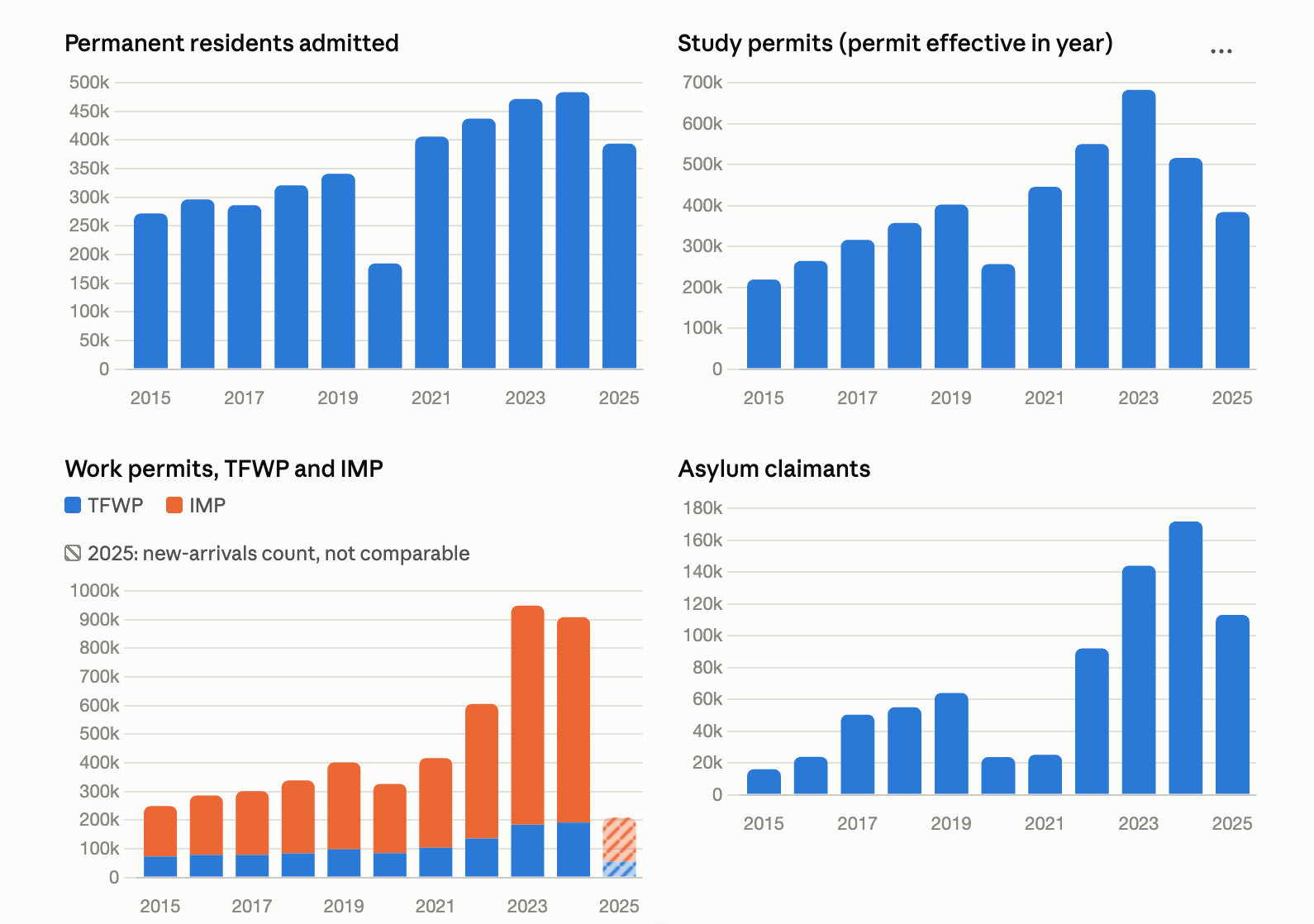
The government did reduce intake for 2025, but only down to 393,775, which is still more than a 50 per cent increase over the roughly 250,000 a year we used to bring in.
When you look across all categories, more than 2.1 million people came in via all streams in 2024 compared to 756,000 in 2015, the last year of the Harper government. In 2025, our total numbers were still well over 1 million, which is a massive hike over those traditional norms.
In 2024, 7.5 per cent of our total population was made up of temporary residents. The government has pledged to bring that figure down to below 5 per cent. The historic norm is under 3 per cent and, right now, even with all the much-ballyhooed reductions in numbers, temporary residents make up 6.6 per cent of our current population.
So yes, the numbers are down from their peak, but they remain far above historic norms, and Carney is already signalling they could rise again.
Meanwhile, Timmy’s goes under…
You’ve likely heard the story of the Tim Hortons franchisee who has filed for bankruptcy, and part of the reason, according to court filings, is that they can’t afford staff with the foreign worker cutbacks. This particular franchisee owns six locations in Eastern Ontario, places like Hawkesbury, Dunvegan, Vankleek Hill and L’Orignal.
This is small-town Ontario, highly Francophone, and you’re telling me you can’t find locals and need to bring in Indian nationals to work in these remote locations and, without them, you can’t make money?
I’m not buying it.
If a business model only works when most of the staff come from a temporary foreign worker program, then maybe the problem isn’t a labour shortage. Maybe it’s the business model.
Overall, 26 per cent of this owner’s staff were from the TFW program, but one shop had 83 per cent foreign workers and another had 60 per cent.
That goes against the regulations surrounding a program that is being abused all over the place.
“The Government of Canada significantly restricted Temporary Foreign Worker programs,” M.G.B. Ventures Inc. submitted to Ontario Superior Court. “As a result the company employs a lower number of temporary foreign workers.”
Enter the Notorious M.R.G…
I’m not sure that Michelle Rempel Garner, the Conservative Party’s immigration critic, likes the nickname that I’ve given her, but it fits. She’s been on this file for a while, knows it inside and out, and bases her critiques of the Liberal government’s immigration performance on real numbers, facts and figures.
On Wednesday, she held a news conference to call out Carney’s suggested plan of increasing immigration. She pointed to the problems these high numbers have caused and, like me, noted that they aren’t going down as much as they need to.
“Liberal mass immigration policies have created a youth jobs crisis. They’ve caused emergency rooms to overflow, driven healthcare wait lists across the country out of control, placed massive strain on social welfare programs and provincial education systems, sent rents soaring, and shattered Canada’s long-standing consensus on immigration,” M.R.G. said.
“That’s not fair to anyone.”
That’s the part that too many people don’t get. This system isn’t fair to Canadian citizens, to immigrants who are already here and struggling to get on their feet, and it’s not fair to the people we are cramming into the country, in the words of Justin Trudeau, “faster than we can absorb them.”
“On top of all these issues, Prime Minister Carney’s government issued 112,000 new temporary foreign worker permits and 174,000 new foreign student work permits between January and July 2026,” M.R.G. said.
“To put that in perspective, that’s roughly the population of a city the size of Saskatoon added to Canada in just seven months. That’s crazy.”
Carney says the system is finally under control. Maybe. But if the goal is getting back to sustainable immigration levels that Canadians can absorb, we’re nowhere near there yet. And before Ottawa starts talking about increasing the numbers again, it should prove it can handle the numbers we already have.
We know what this monster is up to. His target is 100 million by 2050. This is the goal that the globalists have set for him, and he will do his best to achieve it to get his bonus.
Con Carnage Carney has LIED once again. Can he plea the 5th 111 times! He bankrupted the UK & UN and now Canada.